
Protective clothing is essential in industries where workers may be exposed to hazardous dust, chemical splashes, and potentially dangerous particles. From pharmaceutical manufacturing to construction, agriculture, and industrial cleaning, choosing the right protective coverall can help reduce workplace exposure and improve worker safety.
One common type of protective clothing is the Type 5/6 coverall. These coveralls are designed to provide protection against specific particulate and liquid-splash hazards, depending on their classification and certified performance.
But what does Type 5 6 coverall mean? How does this protective clothing work, and which industries use it?
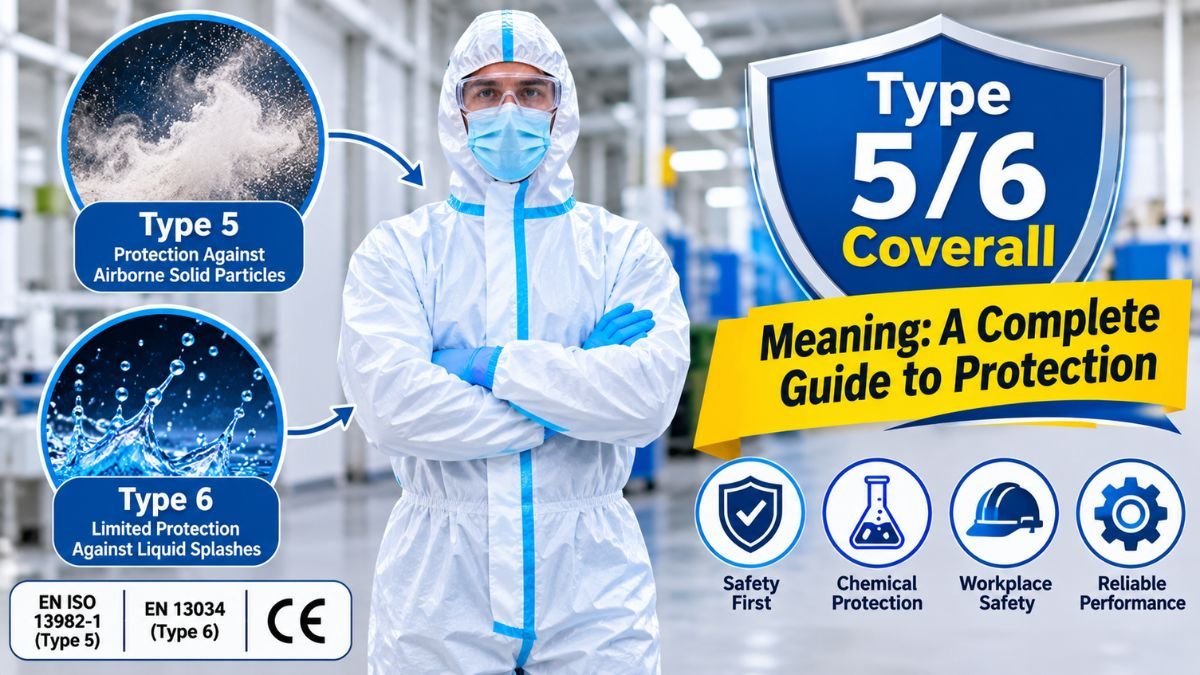
Type 5/6 coveralls are protective garments designed to provide limited protection against hazardous dry particles and certain light liquid sprays or splashes. Type 5 relates to protection against hazardous airborne solid particles, while Type 6 relates to limited protection against light liquid sprays and splashes.
Understanding the difference between these classifications helps employers and workers select suitable protective clothing for their working environments.
In this complete guide, we will explain the Type 5/6 coverall meaning, its protection levels, materials, applications, benefits, limitations, and how to choose the right coverall for your workplace.
Sourcing Type 5/6 coveralls? Explore our protective workwear manufacturing services, see the safety bib & brace overall, and read EN 13034 Type 6 requirements.
What Does Type 5 6 Coverall Mean?
The term Type 5/6 coverall refers to a protective garment designed to meet two categories of chemical protective clothing performance requirements under the European PPE framework.
These classifications are associated with the EN ISO 13982-1 and EN 13034 standards.
- Type 5: Protective clothing providing protection for the whole body against airborne solid particles.
- Type 6: Protective clothing providing limited protection against light liquid sprays and splashes.
A Type 5/6 coverall combines these two protective functions in a single garment, provided it has been appropriately tested and certified for both types.
These garments are commonly used in workplaces where workers need protection from dust, powder, fibers, and occasional light liquid splashes.
However, Type 5/6 coveralls are not designed to protect against every chemical hazard. Their suitability depends on the specific substance, exposure conditions, garment certification, and workplace risk assessment.
What Is a Type 5 Coverall?
A Type 5 coverall is designed to protect the wearer against hazardous airborne solid particles.
These particles may include certain industrial dusts, powders, fibers, and other solid contaminants.
Type 5 garments are tested for their ability to limit the inward leakage of airborne particles under specified test conditions.
Typical applications may include selected powder-handling operations, pharmaceutical production, insulation work, and industrial cleaning.
The suitability of a Type 5 coverall depends on the hazard involved. Not every Type 5 garment is suitable for every type of dust, especially highly hazardous particles that require specialized protective equipment and a comprehensive exposure-control program.
What Is a Type 6 Coverall?
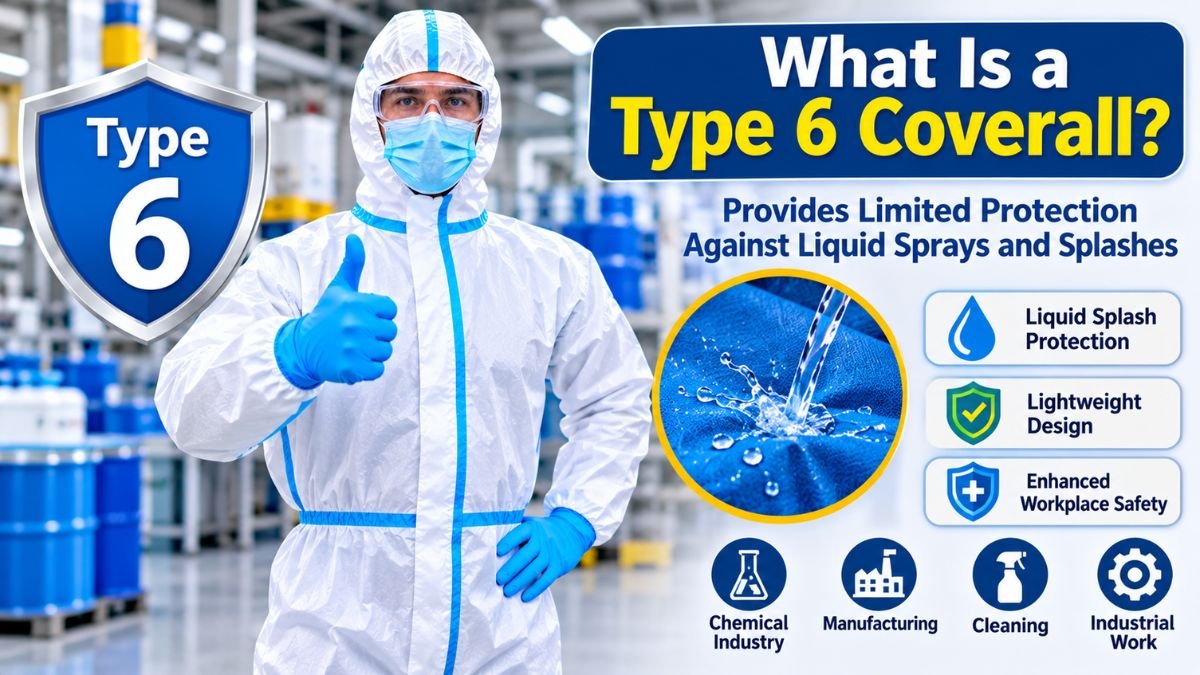
A Type 6 coverall is designed to provide limited protection against light liquid sprays and splashes.
It is generally used in environments where workers may encounter small amounts of liquid chemicals rather than sustained exposure or heavy chemical spraying.
Depending on the risk assessment and garment certification, applications may include certain cleaning operations, maintenance work, agricultural activities, and industrial processes involving limited liquid exposure.
Type 6 protection does not mean that a garment is resistant to all chemicals. A liquid may penetrate or degrade a material even if the garment meets Type 6 requirements.
Always verify chemical compatibility before selecting protective clothing.
Difference Between Type 5 and Type 6 Coveralls
Although Type 5 and Type 6 coveralls are both used for protective purposes, they address different types of exposure.
| Feature | Type 5 Coverall | Type 6 Coverall |
|---|---|---|
| Main protection | Airborne solid particles | Limited liquid sprays and splashes |
| Typical hazards | Certain dusts, powders, and fibers | Light splashes of compatible liquids |
| Main performance focus | Limiting inward particle leakage | Demonstrating limited liquid-spray and splash protection |
| Common applications | Powder handling, selected industrial cleaning, and some insulation work | Certain maintenance, cleaning, and agricultural tasks |
| Protection against heavy liquid exposure | Not its intended purpose | Not its intended purpose |
| Protection against gas or vapor | Not provided by the Type 5 classification | Not provided by the Type 6 classification |
| Chemical resistance | Depends on the specific material and garment | Depends on the specific material and garment |
A Type 5/6 coverall combines both classifications when the garment is certified to meet the relevant requirements.
The key point is that Type 5 protects against specified airborne solid-particle hazards, while Type 6 provides limited protection against certain light liquid sprays and splashes.
Neither classification automatically makes a garment suitable for every hazardous environment.
What Standards Apply to Type 5/6 Coveralls?
Understanding protective clothing standards helps employers select appropriate equipment and verify product claims.
Two important European standards associated with Type 5/6 protective clothing are EN ISO 13982-1 and EN 13034.
EN ISO 13982-1: Type 5 Protection
EN ISO 13982-1 specifies performance requirements for chemical protective clothing providing protection for the whole body against airborne solid particles.
This standard is relevant to Type 5 protective coveralls.
It addresses garment performance under specified test conditions, including the ability to limit the inward leakage of particles.
However, meeting this standard does not mean a garment provides complete protection against every airborne substance or particle size.
EN 13034: Type 6 Protection
EN 13034 specifies requirements for chemical protective clothing offering limited protective performance against liquid chemicals.
Use Type 6 garments in situations involving potential exposure to light sprays, liquid aerosols, or low-volume splashes where you do not require a complete liquid barrier.
The standard includes performance requirements and testing relevant to limited liquid protection.
Because Type 6 clothing provides limited protection, do not treat it as a substitute for chemical suits designed for more severe liquid exposure.
Why Certification Matters
When purchasing Type 5/6 coveralls, check the manufacturer’s documentation and garment label.
Look for:
- The stated protection type.
- Relevant standards and editions.
- CE marking where applicable.
- The manufacturer’s name and product identification.
- Instructions for use and limitations.
- Any applicable chemical compatibility information.
Verify certification and labeling against the requirements of the market where you will use the garment.
Employers should also consider the specific workplace hazard rather than selecting coveralls based on the Type 5/6 label alone.
For test details on Type 6, read EN 13034 Type 6 requirements. For wider protection levels, see types of chemical protective clothing.
What Materials Are Used in Type 5/6 Coveralls?
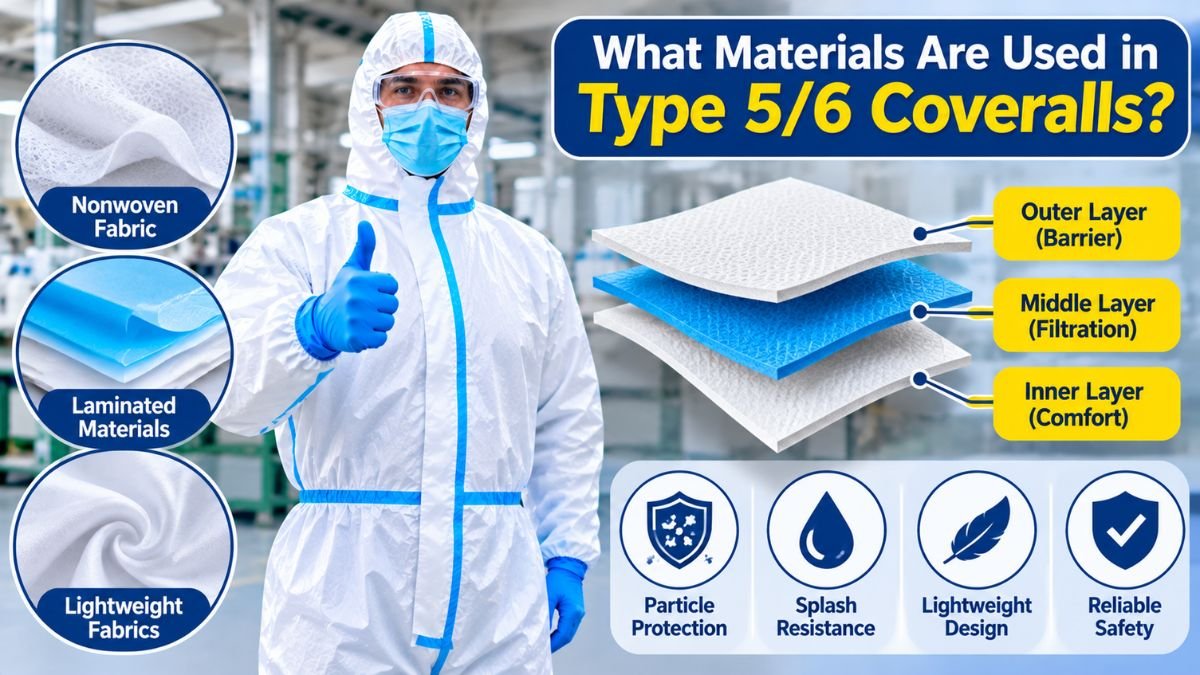
Manufacturers manufacture Type 5/6 coveralls from materials selected to provide the required particle and limited liquid-splash performance.
Common material constructions include specialized nonwoven fabrics, laminated materials, and multilayer structures.
The exact composition depends on the manufacturer, product design, and intended application.
1. Spunbond-Meltblown Nonwoven Materials
Some disposable protective coveralls use nonwoven fabric structures that combine strength with particle-barrier performance.
Spunbond layers can provide mechanical strength, while other layers may contribute to filtration or barrier properties.
However, the presence of a particular fabric structure does not automatically establish Type 5/6 compliance. The complete garment must meet the relevant requirements.
2. Laminated Protective Materials
Some coveralls use laminated fabrics or films to improve resistance to liquid penetration and provide a suitable protective barrier.
You may select these materials for tasks involving both airborne particles and limited liquid splashes.
Their performance depends on the laminate construction, seams, closures, and overall garment design.
3. Lightweight Disposable Materials
Many manufacturers design Type 5/6 coveralls for single-use applications.
Lightweight construction can make them practical for short-duration tasks and situations where garments may become contaminated.
You should use, remove, and dispose of disposable coveralls according to the manufacturer’s instructions and applicable workplace procedures.
4. Reusable Protective Materials
Some manufacturers design protective garments for repeated use, provided you can safely clean, inspect, and maintain them.
Reusable garments require specific care instructions and may have limitations on washing, decontamination, or service life.
Do not assume that you can reuse a Type 5/6 coverall simply because it appears undamaged after use.
Common Applications of Type 5/6 Coveralls
Workers use Type 5/6 coveralls across a range of industries where they may encounter hazardous particles or limited liquid exposure.
You must always select the correct garment according to the workplace risk assessment.
1. Pharmaceutical Manufacturing
Pharmaceutical production may involve handling powders, raw materials, and other substances that require contamination control.
Suitable Type 5 coveralls may help limit the transfer of particles between the worker and the working environment.
However, pharmaceutical cleanroom clothing requirements are not necessarily the same as chemical protective clothing requirements. You should only use a Type 5/6 garment when it meets the specific hygiene, contamination-control, and safety requirements of the process.
2. Construction and Insulation Work
Some construction and insulation tasks involve airborne dust, fibers, or other solid particles.
Appropriately selected Type 5 coveralls may help reduce contamination of workers’ clothing and skin.
For hazardous insulation materials, including asbestos, workers must follow applicable regulations, exposure-control procedures, and specialized protective equipment requirements. A Type 5/6 label alone does not establish that a coverall is suitable for asbestos work.
3. Industrial Cleaning
Industrial cleaning may involve dust, powders, and occasional contact with cleaning liquids.
A Type 5/6 coverall may suit certain tasks when the garment stays compatible with the substances involved and the exposure level stays within its intended protection category.
Tasks involving concentrated chemicals, high-pressure sprays, or significant liquid exposure may require different protective clothing.
4. Agriculture
Agricultural workers may encounter dust, powders, and certain liquid products during selected activities.
Type 5/6 coveralls may suit some lower-exposure tasks, depending on the product you handle.
Pesticides and other agricultural chemicals have specific protective equipment requirements. Always follow the product label, safety data sheet, and applicable regulations rather than assuming that Type 5/6 protection is sufficient.
5. Food and General Manufacturing
Some manufacturing operations require protective garments to control dust, fibers, or product contamination.
Type 5/6 coveralls may be appropriate for certain tasks when their protective properties align with the hazards involved.
For food processing, you must also consider hygiene standards and food-contact requirements.
Benefits of Type 5/6 Coveralls
Type 5/6 coveralls offer several potential advantages when used for suitable applications.
1. Combined Particle and Limited Splash Protection
A certified Type 5/6 garment provides two types of protection in one coverall.
This can be useful in work environments where both airborne particles and occasional light liquid splashes are possible.
2. Lightweight Construction
Many disposable Type 5/6 coveralls use lightweight materials that support ease of movement during routine tasks.
Comfort depends on the garment’s design, fit, fabric, and the conditions in which you wear it.
3. Reduced Contamination of Personal Clothing
Protective coveralls can help prevent dust and other contaminants from reaching the worker’s everyday clothing.
This may support workplace hygiene and simplify contamination-control procedures.
4. Convenient Disposable Options
Single-use coveralls can be practical for jobs where clothing becomes contaminated and cleaning is difficult or unsuitable.
They may reduce the need for laundering, provided they are disposed of correctly.
5. Availability in Different Designs
Manufacturers offer protective coveralls with different closure systems, hood designs, cuffs, and fits.
These options help employers select garments that work with the task and other required personal protective equipment.
However, a convenient design should never take priority over the protection required by the hazard assessment.
Limitations of Type 5/6 Coveralls
Although Type 5/6 coveralls provide useful protection for certain applications, they have important limitations.
1. Not Suitable for Every Chemical
A Type 5/6 coverall is not automatically resistant to every chemical.
The material may degrade, swell, or allow penetration when exposed to an incompatible substance.
Check the manufacturer’s chemical compatibility information before use.
2. Limited Liquid Protection
Manufacturers design Type 6 garments for limited liquid-spray and splash exposure.
Manufacturers do not intend them to provide protection against sustained liquid contact, heavy spraying, or immersion.
More protective chemical clothing may be necessary for these hazards.
3. No Automatic Gas or Vapor Protection
Type 5/6 classification does not establish protection against gases or vapors.
Work involving hazardous gases, vapors, or oxygen-deficient atmospheres requires a separate assessment and suitable protective equipment.
4. Fit and Design Affect Protection
A coverall’s protective performance depends on more than its fabric.
Closures, seams, cuffs, hood design, and the interface with gloves, footwear, and respiratory protection can all influence protection.
Choose a garment size that allows appropriate movement while maintaining the intended coverage.
5. Contamination Can Create Additional Hazards
A contaminated coverall may expose workers during removal, handling, or disposal.
Follow appropriate donning, doffing, and contamination-control procedures to avoid transferring hazardous substances to skin, clothing, or clean areas.
How to Choose the Right Type 5/6 Coverall
Selecting suitable protective clothing begins with understanding the workplace hazards.
Follow these steps to make an informed decision.
Step 1: Identify the Hazard
Determine whether workers may be exposed to airborne solid particles, liquid splashes, or both.
Identify the substances involved, their hazardous properties, and the likely routes of exposure.
Review the safety data sheets and applicable workplace risk assessments.
Step 2: Check the Required Protection Type
If the task involves airborne solid particles, consider whether Type 5 protection is appropriate.
If limited liquid splashes are also possible, determine whether a certified Type 5/6 garment meets the requirements.
More severe chemical hazards may require a different category of protective clothing.
Step 3: Review the Garment Certification
Check the garment label and manufacturer’s documentation for the applicable standards and declared protection types.
Do not rely solely on product descriptions or marketing claims.
Step 4: Assess Material Compatibility
Verify that the garment material is suitable for the actual substances encountered during the task.
Consider chemical concentration, temperature, contact duration, and the possibility of repeated exposure.
Step 5: Consider Comfort and Fit
A well-fitting coverall should provide the required coverage while allowing workers to perform their tasks safely.
Consider garment sizing, hood design, cuffs, closures, and compatibility with other PPE.
Step 6: Review Disposal or Reuse Requirements
Determine whether the garment is disposable or reusable.
Follow the manufacturer’s instructions for cleaning, storage, inspection, and disposal.
If hazardous substances have contaminated a garment, follow the relevant waste-handling procedures.
How to Wear Type 5/6 Coveralls Correctly
Correct use is essential for obtaining the intended protection from a Type 5/6 coverall.
Before wearing the garment, inspect it for damage and confirm that it is suitable for the task.
Follow the manufacturer’s donning instructions.
General precautions include:
- Select the correct garment size.
- Check zippers, seams, cuffs, and closures.
- Use compatible gloves and footwear where required.
- Ensure that the hood and other garment components are positioned correctly.
- Check compatibility with required respiratory protection.
- Avoid modifying the garment unless the manufacturer permits it.
- Follow workplace procedures when removing contaminated clothing.
Removing protective clothing can create a risk of transferring contaminants to the skin or other surfaces. Workers should receive appropriate training in safe doffing procedures.
If the garment tears, becomes heavily contaminated, or no longer provides the required coverage, follow workplace procedures for replacement.
Type 5/6 Coveralls vs. Other Protective Coverall Types
Different categories of chemical protective clothing are designed for different exposure conditions.
The following table provides a general comparison of common European Type classifications.
| Coverall Type | General Protection Purpose | Typical Exposure Conditions |
|---|---|---|
| Type 1 | Gas-tight chemical protective clothing | Specified hazardous environments involving gases, subject to the garment’s design and requirements |
| Type 2 | Non-gas-tight chemical protective clothing | Specialized applications involving inward leakage control under specified conditions |
| Type 3 | Protection against pressurized liquid jets | Certain tasks involving high-pressure liquid exposure |
| Type 4 | Protection against liquid sprays | Certain tasks involving spray exposure |
| Type 5 | Protection against airborne solid particles | Selected dusty or powder-handling environments |
| Type 6 | Limited protection against liquid sprays and splashes | Selected low-level liquid exposure situations |
| Type 5/6 | Combined Type 5 and Type 6 protection | Suitable tasks involving specified particle hazards and limited liquid splashes |
The table is a general overview, not a substitute for the relevant standards or a workplace risk assessment.
The higher or lower number does not mean that a garment is universally more or less protective. Each classification addresses different test conditions and exposure types.
Choose the coverall according to the specific hazard rather than comparing classifications by number alone.
How to Store and Maintain Type 5/6 Coveralls
Proper storage and handling help preserve protective clothing before use.
Store Unused Coveralls Properly
Keep unused coveralls in their original packaging or another suitable clean storage location.
Protect them from excessive heat, direct sunlight, moisture, and other conditions that may damage the material.
Inspect Before Use
Check for tears, punctures, damaged seams, and defective closures.
Do not use a damaged garment if its integrity may be compromised.
Follow Reuse Instructions
Only reuse garments when the manufacturer explicitly permits reuse and the garment remains suitable for service.
Disposable garments should not be washed and reused unless the manufacturer specifically allows it.
Dispose of Contaminated Coveralls Safely
The correct disposal method depends on the contaminant and applicable regulations.
Coveralls contaminated with hazardous chemicals or other dangerous materials may require special handling and designated waste-disposal procedures.
Never assume that contaminated protective clothing can be placed in ordinary waste.
Frequently Asked Questions About Type 5/6 Coveralls
1. What does Type 5/6 coverall mean?
A Type 5/6 coverall is protective clothing certified to provide Type 5 protection against airborne solid particles and Type 6 protection against limited liquid sprays and splashes.
2. What is the difference between Type 5 and Type 6 coveralls?
Type 5 coveralls are designed for specified airborne solid-particle hazards. Type 6 coveralls provide limited protection against light liquid sprays and splashes.
3. Are Type 5/6 coveralls waterproof?
Not necessarily. Type 6 protection does not mean that a coverall is waterproof or suitable for prolonged liquid contact. Its performance is limited to the relevant classification requirements.
4. Can Type 5/6 coveralls protect against chemicals?
They may provide protection against certain chemicals under specified exposure conditions, but the classification alone does not establish compatibility with every chemical.
Always check the manufacturer’s chemical compatibility information and the workplace risk assessment.
5. Are Type 5/6 coveralls disposable?
Many are designed for single use, but some protective garments may be reusable. Follow the manufacturer’s instructions regarding reuse, cleaning, and disposal.
6. Are Type 5/6 coveralls suitable for asbestos work?
A Type 5 classification alone does not establish that a coverall is suitable for asbestos work. Selection must follow applicable asbestos regulations, exposure-control procedures, and the requirements for the complete protective equipment system.
7. Can Type 5/6 coveralls be used for pesticide spraying?
Suitability depends on the pesticide, application method, exposure level, and product-specific protective equipment requirements. Follow the pesticide label, safety data sheet, and applicable regulations.
8. What standards apply to Type 5/6 coveralls?
EN ISO 13982-1 is associated with Type 5 protection against airborne solid particles, while EN 13034 is associated with Type 6 limited protection against liquid chemicals.
Always verify the applicable standards and certification on the garment documentation.
9. Are Type 5/6 coveralls suitable for industrial cleaning?
They may be suitable for selected industrial cleaning tasks involving airborne particles and limited liquid splashes. Tasks involving concentrated chemicals, heavy spraying, or significant liquid exposure may require different protective clothing.
10. How do I know whether a Type 5/6 coverall is suitable for my workplace?
Identify the hazards, review the risk assessment, check the manufacturer’s documentation, and confirm that the garment’s certified performance matches the expected exposure conditions.
Consult a qualified safety professional when the hazards or protection requirements are unclear.
Conclusion
Understanding the Type 5 6 coverall meaning is essential when selecting protective clothing for industrial and workplace applications.
Type 5 coveralls are designed to protect against specified airborne solid particles, while Type 6 coveralls provide limited protection against light liquid sprays and splashes. A certified Type 5/6 coverall combines both forms of protection for appropriate working conditions.
These garments are used in industries such as manufacturing, construction, pharmaceutical production, agriculture, and industrial cleaning. However, their suitability depends on the specific hazards, material compatibility, garment design, and exposure conditions.
Before choosing a Type 5/6 coverall, review the relevant certification, assess the workplace risks, and follow the manufacturer’s instructions for use, maintenance, and disposal.
The most important rule is to select protective clothing based on the actual hazard, not simply on its classification. Proper garment selection, correct use, and worker training help support a safer working environment.
1 thought on “Type 5 6 Coverall Meaning: A Complete Guide to Protection”
Pingback: Types of Chemical Protective Clothing for Workplace Safety - negorafist.com