

Chemical protective clothing is essential in workplaces where employees may come into contact with hazardous liquids, chemical sprays, or accidental splashes. Industries such as manufacturing, chemical processing, pharmaceuticals, agriculture, and industrial cleaning often require specialized protective garments to help reduce the risk of chemical exposure.
One important European standard for this type of protective clothing is EN 13034:2005+A1:2009. It specifies performance requirements for clothing that provides limited protection against liquid chemicals, including Type 6 coveralls and Type PB [6] partial-body protective garments.
But what does EN 13034:2005+A1:2009 Type 6 actually mean? What protection does it provide, and how can businesses determine whether this clothing is suitable for their workers?
EN 13034:2005+A1:2009 Type 6 is a standard for chemical protective clothing designed for situations involving potential exposure to light liquid sprays, liquid aerosols, or low-pressure, low-volume splashes. It is intended for applications where a complete liquid barrier is not required.
Understanding this standard helps employers, safety professionals, and clothing buyers choose protective garments according to the hazards present in their working environments.
In this complete guide, we will explain the EN 13034 Type 6 standard, its requirements, testing procedures, applications, benefits, limitations, and how to select suitable chemical protective clothing.
Sourcing Type 6 coveralls? Explore our protective workwear manufacturing services, see the safety bib & brace overall, and read the meaning of Type 5/6 coveralls.
What Is EN 13034:2005+A1:2009?
EN 13034:2005+A1:2009 is a European standard titled Protective clothing against liquid chemicals — Performance requirements for chemical protective clothing offering limited protective performance against liquid chemicals (Type 6 and Type PB [6] equipment).
The standard establishes minimum performance requirements for limited-use and reusable chemical protective clothing intended for specific low-level liquid exposure conditions.
It covers two main categories:
- Type 6: Chemical protective suits that cover the body and provide limited protection against liquid chemicals.
- Type PB [6]: Partial-body protective garments, such as chemical-resistant aprons, jackets, or sleeves, designed to protect specific areas of the body.
The standard addresses garment materials, seams, joins, construction, and the protective performance of complete Type 6 suits.
It is particularly relevant when workers may encounter occasional splashes or light sprays but do not require a complete liquid chemical barrier.
The standard’s scope and requirements are described by standards organizations, including the Swedish Institute for Standards and the British Standards Institution.
What Does the Standard Number Mean?
The number and amendment designation identify the published standard and its revision.
- EN: European Standard.
- 13034: The standard number associated with limited-performance chemical protective clothing against liquid chemicals.
- 2005: The year of the original standard edition.
- A1:2009: Amendment 1, issued in 2009.
When purchasing protective clothing, verify the exact standard and certification information supplied by the manufacturer. Also check the applicable regulatory requirements for the market where the garments will be sold or used.
What Does Type 6 Protection Mean?
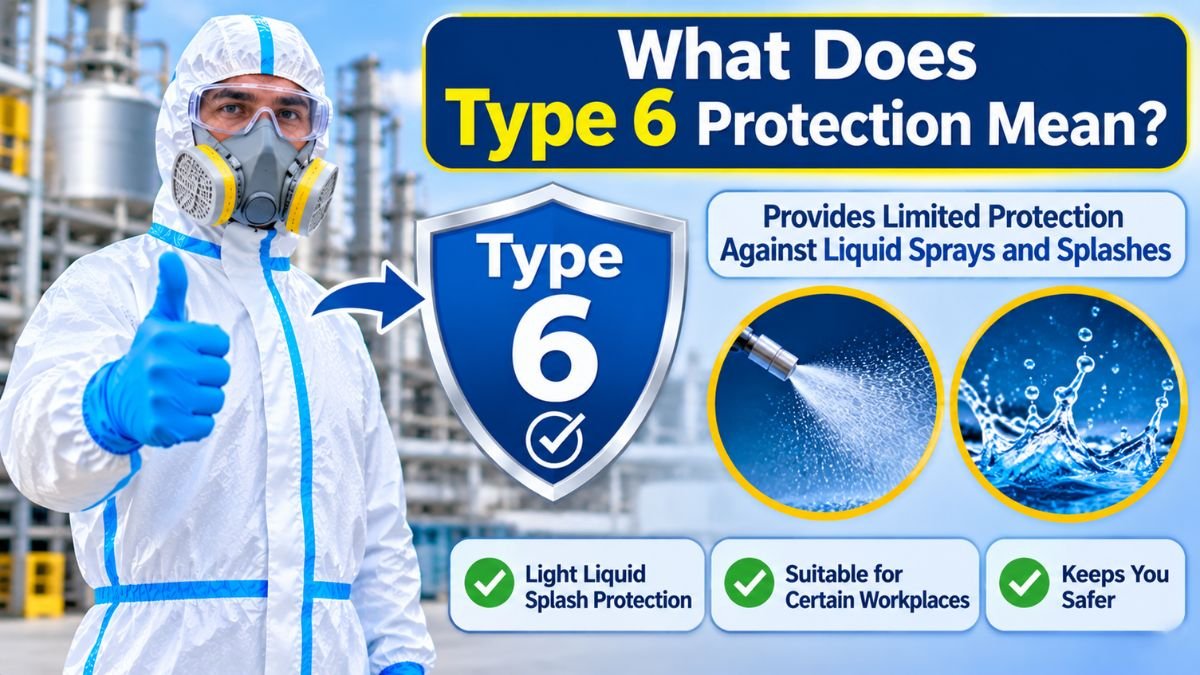
Type 6 protection refers to limited-performance chemical protective clothing intended for certain low-level liquid exposure situations.
These garments are designed to help reduce the risk of liquid chemicals reaching the wearer’s clothing or skin under specified test conditions.
Type 6 clothing is commonly available as a one-piece coverall or a two-piece suit. Depending on the product design, it may include a hood, elasticated cuffs, ankle closures, and other features intended to improve coverage.
However, Type 6 protection has important limitations.
It is not designed to provide a complete barrier against every liquid chemical, and it should not automatically be used where workers may experience heavy chemical spraying, pressurized liquid jets, immersion, or prolonged chemical contact.
The suitability of a garment depends on the substance involved, its concentration, the expected exposure, and the manufacturer’s documented performance information.
Key Characteristics of Type 6 Clothing
Type 6 chemical protective clothing generally offers the following characteristics:
Limited liquid-splash protection: Designed for specified light sprays and low-pressure, low-volume splashes.
Full-body coverage: Type 6 suits cover at least the trunk and limbs, although the precise design and accessories vary.
Tested garment construction: The complete suit must meet the applicable performance requirements, including requirements relating to its connections and resistance to liquid penetration under specified conditions.
Potentially lightweight construction: Many Type 6 coveralls use lightweight materials that support movement during routine industrial tasks.
Limited-use or reusable options: The standard covers both limited-use and reusable protective clothing, subject to the garment’s design and care instructions.
These characteristics make Type 6 clothing useful for selected applications where limited chemical protection is appropriate.
What Are the Main Requirements of EN 13034 Type 6?
EN 13034:2005+A1:2009 addresses several aspects of protective clothing performance. These requirements help establish whether a garment is suitable for its intended category of chemical protection.
1. Resistance to Liquid Penetration
Liquid penetration occurs when a chemical passes through a material, seam, or other part of a garment.
Type 6 clothing is evaluated to determine whether it meets the required resistance to liquid penetration under the specified test conditions.
The purpose is to help reduce the possibility of hazardous liquid reaching the wearer during the intended use of the garment.
However, passing the relevant tests does not mean that a garment is resistant to every chemical or every exposure condition.
2. Liquid Repellency
Liquid repellency describes the ability of a material to resist wetting by a liquid.
Repellent materials may cause some liquids to bead up or run off the surface rather than immediately wetting the fabric.
Repellency is different from resistance to penetration. A liquid may be repelled by the surface but still penetrate the material under certain conditions.
For this reason, both properties are important when evaluating chemical protective clothing.
3. Whole-Suit Spray Testing
The standard includes a test for the complete Type 6 suit to evaluate resistance to penetration by a light spray.
This testing considers the garment as a complete system rather than examining the fabric alone.
The suit’s seams, closures, and connections can affect its performance, so the overall construction is important.
A fabric that performs well in an individual material test does not automatically guarantee that the finished coverall will provide the intended protection.
4. Seam and Construction Performance
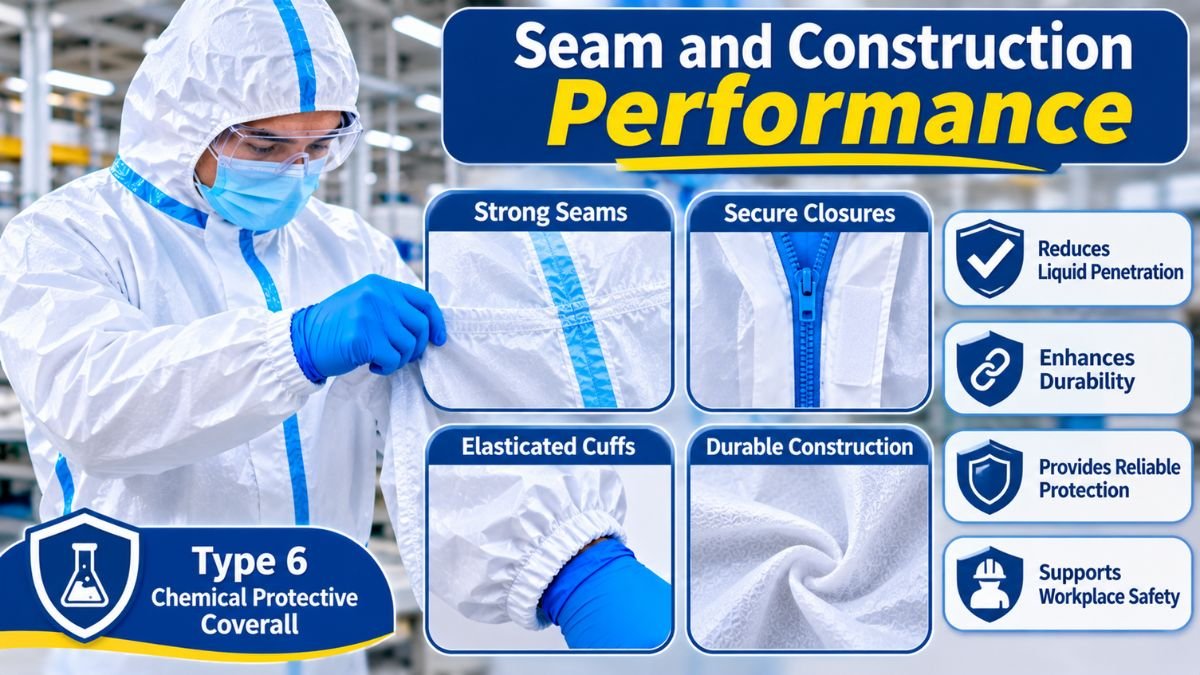
Seams and joins are potential points where liquids may enter a garment.
The standard includes performance requirements relating to seams, joins, and other assembled parts of the clothing.
Manufacturers must consider garment construction when designing protective coveralls.
Depending on the product, features such as suitable seam construction, secure closures, and carefully designed openings can help support the intended protective performance.
5. Material Strength and Durability
Protective clothing must also meet applicable material performance requirements.
Relevant properties may include resistance to abrasion, tearing, tensile stress, puncturing, and flex cracking.
These characteristics matter because a garment that tears or becomes damaged during use may no longer provide its intended protection.
The precise requirements and performance classes should be checked in the applicable standard and the manufacturer’s documentation.
For the Type 5 side of the classification, see the meaning of Type 5/6 coveralls. For other protection levels, read about types of chemical protective clothing.
How Is Type 6 Chemical Protective Clothing Tested?
Testing is an important part of determining whether a protective garment meets the requirements of EN 13034.
The evaluation considers material performance and the behavior of the complete garment under specified conditions.
Step 1: Material Testing
The garment material is evaluated using relevant test methods to determine its physical and chemical-protection performance.
Depending on the test, this may include evaluating liquid repellency, penetration resistance, and mechanical strength.
These tests help identify whether the material meets the required performance criteria.
Step 2: Testing Against Specified Chemicals
The standard includes testing with specified reference chemicals to assess material performance.
Examples of reference test liquids associated with EN 13034 evaluations include sulfuric acid solution, sodium hydroxide solution, o-xylene, and butan-1-ol.
These tests provide information about the material’s performance against the specified test liquids.
Important: Passing tests with reference chemicals does not establish that a garment is suitable for every chemical used in a workplace. Additional chemical-specific compatibility information may be necessary.
Step 3: Seam and Assembly Evaluation
The seams, joins, and other assembled parts of the garment are assessed against the applicable requirements.
This helps establish whether the garment’s construction is appropriate for its intended protection category.
Step 4: Whole-Garment Spray Testing
The finished Type 6 suit undergoes the applicable spray test to evaluate resistance to liquid penetration under specified conditions.
This is important because liquid may enter through areas other than the main fabric.
Step 5: Review of Performance Information
The results and relevant product documentation help establish the garment’s performance characteristics.
Buyers should review the manufacturer’s documentation, certification, user instructions, and stated limitations before choosing a garment.
The standard’s testing framework is intended to evaluate limited-performance chemical protective clothing rather than provide universal protection against all liquid chemicals.
Type 6 vs. Type 5 Protective Coveralls
In the type 5 and Type 6 coveralls are designed for different types of exposure.
Type 5 clothing is intended to protect against specified airborne solid particles, while Type 6 clothing provides limited protection against certain liquid sprays and splashes.
Some garments are certified for both categories and are commonly described as Type 5/6 coveralls.
The following table explains the main differences.
| Feature | Type 5 Coveralls | Type 6 Coveralls |
|---|---|---|
| Main purpose | Protection against airborne solid particles | Limited protection against liquid chemicals |
| Main exposure | Dusts and powders | Light sprays, liquid aerosols, and low-volume splashes |
| Relevant standard | EN ISO 13982-1 | EN 13034:2005+A1:2009 |
| Full-body options | Yes | Yes |
| Partial-body options | Depends on the applicable garment standard | Type PB [6] covers specific body areas |
| Protection against heavy liquid exposure | Not the intended purpose | Not the intended purpose |
| Protection against gases and vapors | Not established by Type 5 classification | Not established by Type 6 classification |
| Combined protection | Available in certified Type 5/6 garments | Available in certified Type 5/6 garments |
The most important difference is the hazard being addressed. Neither classification is universally superior to the other.
Employers should select protective clothing according to the workplace risk assessment and the specific performance requirements of the task.
What Is the Difference Between Type 6 and Type PB [6]?
EN 13034 covers both Type 6 suits and Type PB [6] partial-body protective garments.
Although these categories share the same general limited-performance protection concept, they differ in how much of the body the garment is designed to cover.
Type 6: Full-Body Chemical Protective Clothing
Type 6 suits are designed to cover at least the trunk and limbs.
Examples include:
- One-piece chemical protective coveralls.
- Two-piece protective suits.
- Suits with or without an integrated hood.
- Garments with optional boot socks or boot covers, depending on the design.
The complete suit is subject to the relevant whole-suit performance requirements.
Type PB [6]: Partial-Body Protection
Type PB [6] garments are designed to protect specific parts of the body rather than provide full-body coverage.
Examples include:
- Chemical protective aprons.
- Protective jackets.
- Sleeves.
- Other garments designed to cover selected body areas.
These products may be suitable when the risk assessment identifies a limited area of potential exposure.
However, the selected garment must provide appropriate coverage for the task. Partial-body protection should not be treated as equivalent to a full-body suit when broader protection is necessary.
Which Industries Use EN 13034 Type 6 Clothing?
Type 6 protective clothing is used in various industries where workers may encounter limited liquid chemical exposure.
Its suitability depends on the actual substance, working conditions, and required level of protection.
1. Chemical Manufacturing
Workers in chemical manufacturing may encounter occasional splashes during certain handling, inspection, or maintenance activities.
A suitable Type 6 garment may be appropriate when the risk assessment confirms that the exposure conditions fall within its intended protection category.
Processes involving highly hazardous chemicals, concentrated liquids, or substantial splash risks may require more protective clothing.
2. Industrial Cleaning
Some cleaning and maintenance operations involve detergents, cleaning solutions, and other liquids.
Type 6 coveralls may be suitable for selected tasks where only limited splashes are expected.
However, the compatibility of the garment with the cleaning chemical must be confirmed before use.
3. Pharmaceutical Manufacturing
Pharmaceutical facilities may use protective clothing to manage both worker exposure and product contamination.
Type 6 clothing may be appropriate for certain tasks involving limited liquid chemical exposure, provided it also meets the facility’s hygiene and process requirements.
Cleanroom suitability and chemical protection are separate considerations, so the garment must meet both where necessary.
4. Agriculture
Agricultural work can involve contact with liquids used in cleaning, maintenance, and selected chemical-handling activities.
Type 6 clothing may be suitable for some tasks, but pesticide application requires special attention.
Always follow the pesticide label, safety data sheet, applicable regulations, and prescribed personal protective equipment requirements.
Do not assume that a Type 6 coverall is appropriate for every agricultural chemical.
5. Automotive and General Manufacturing
Certain manufacturing and maintenance activities may involve limited exposure to oils, cleaning agents, or other liquids.
A Type 6 coverall can be considered when the material is compatible with the substance and the exposure level is appropriate.
Tasks involving prolonged contact, immersion, or hazardous solvent exposure may require a different type of protective clothing.
6. Laboratories and Technical Facilities
Laboratory personnel may work with liquids that can create a splash hazard.
Type 6 clothing may be appropriate for selected activities when the chemical compatibility and exposure conditions have been assessed.
Higher-risk laboratory procedures may require specialized chemical suits, protective aprons, gloves, eye protection, or other equipment.
What Materials Are Used in Type 6 Coveralls?
Type 6 coveralls are manufactured using materials selected to meet the required liquid-protection and physical-performance criteria.
Common material constructions include lightweight nonwoven fabrics, coated textiles, and laminated materials.
The exact composition varies by manufacturer and garment design.
1. Nonwoven Fabrics
Nonwoven fabrics are commonly used in disposable protective coveralls.
They can provide lightweight construction and may be engineered to offer suitable resistance to liquid penetration.
However, not every nonwoven fabric is suitable for Type 6 protection. The material and complete garment must meet the applicable performance requirements.
2. Coated Fabrics
Some protective garments use fabrics with a coating designed to improve resistance to liquid penetration.
The coating, base fabric, seams, and garment design all influence the finished product’s performance.
Chemical compatibility must still be confirmed for the substance involved.
3. Laminated Materials
Laminated materials combine multiple layers to achieve specific barrier and mechanical properties.
These materials may be used in protective garments intended for particular liquid exposure conditions.
Their performance depends on the construction, thickness, bonding process, and overall garment design.
4. Lightweight Disposable Materials
Many Type 6 coveralls are designed for limited use or single-use applications.
Disposable designs can be convenient when garments may become contaminated and laundering is unsuitable.
However, a disposable coverall must still be selected according to the required protection level and the manufacturer’s instructions.
Remember: Material type alone does not prove that a garment meets EN 13034. Check the product’s certification and technical documentation.
Benefits of EN 13034 Type 6 Protective Clothing
When selected and used correctly, Type 6 clothing offers several practical benefits.
1. Protection Against Limited Liquid Exposure
The main benefit is that the garment is designed and tested to provide limited protection against specified liquid-spray and splash conditions.
This can help reduce the risk of liquid chemicals reaching the wearer during suitable tasks.
2. Lightweight Design Options
Many Type 6 coveralls use lightweight materials that allow workers to move during routine activities.
Comfort can be important for tasks involving frequent movement or extended periods of wear.
However, the garment must still provide the coverage and performance required by the risk assessment.
3. Full-Body Coverage
Type 6 suits cover at least the trunk and limbs.
Depending on the garment design, additional features such as a hood, elasticated cuffs, or ankle closures may help improve coverage.
These features do not eliminate the need for correct sizing and proper use.
4. Disposable and Reusable Options
The standard covers both limited-use and reusable protective clothing.
This gives organizations options depending on the nature of the task, contamination risks, maintenance arrangements, and manufacturer’s instructions.
5. Support for Workplace Safety Programs
Selecting suitable chemical protective clothing helps organizations implement their risk-control procedures.
Combined with training, appropriate handling, and other required PPE, Type 6 garments can form part of a broader workplace safety program.
Limitations of EN 13034 Type 6 Clothing
Understanding the limitations of Type 6 clothing is just as important as understanding its benefits.
1. Not Designed for Heavy Chemical Splashes
Type 6 clothing provides limited protection.
It should not be assumed suitable for high-pressure liquid jets, heavy spraying, immersion, or prolonged contact with liquid chemicals.
A more protective garment may be necessary for these conditions.
2. Not Suitable for Every Chemical
Chemical compatibility depends on the garment material, chemical identity, concentration, temperature, and duration of contact.
A garment may resist one substance but perform poorly against another.
Always consult the manufacturer before selecting clothing for a specific chemical.
3. Does Not Automatically Protect Against Gases or Vapors
Type 6 certification does not establish protection against hazardous gases or vapors.
Work involving these hazards requires a separate assessment and appropriately selected protective equipment.
4. Damage Can Reduce Protection
Tears, holes, damaged seams, and defective closures can compromise a garment’s intended performance.
Inspect protective clothing before use and remove damaged items from service according to workplace procedures.
5. Incorrect Use Can Create Additional Risks
An unsuitable size, poor closure, incompatible gloves, or improper removal procedure can create routes for contamination.
Workers should receive training in correct garment selection, donning, use, and doffing.
How to Choose the Right EN 13034 Type 6 Coverall
Choosing suitable chemical protective clothing requires more than checking the label.
Follow these steps to help select the right garment for your workplace.
Step 1: Identify the Chemical Hazard
Identify the substances workers may encounter and determine their hazardous properties.
Review safety data sheets and workplace risk assessments to establish the likely routes and levels of exposure.
Step 2: Evaluate the Exposure Conditions
Consider whether workers may experience light splashes, fine sprays, heavy spraying, or prolonged liquid contact.
Type 6 clothing is intended for limited exposure conditions. More severe hazards may require a different protection category.
Step 3: Check Chemical Compatibility
Confirm that the garment material is suitable for the actual chemical.
Consider concentration, temperature, duration of exposure, and the possibility of repeated contact.
If compatibility information is unavailable, contact the manufacturer before use.
Step 4: Verify Certification
Check the garment label, declaration of conformity where applicable, technical documentation, and instructions for use.
Confirm that the product is certified for the intended protection category under the applicable requirements.
Do not rely solely on marketing descriptions.
Step 5: Assess Garment Fit and Design
Choose a garment that allows workers to perform their tasks without compromising required coverage.
Review hood design, cuffs, closures, seams, and compatibility with other PPE.
Step 6: Consider Reuse and Disposal
Determine whether the garment is designed for single use, limited use, or reuse.
Follow the manufacturer’s cleaning, inspection, storage, and disposal instructions.
If the clothing is contaminated with hazardous chemicals, follow the relevant decontamination and waste-handling procedures.
How to Wear and Maintain Type 6 Coveralls Correctly
Correct use and maintenance help support the intended protective performance of Type 6 garments.
Inspect Before Wearing
Check the garment for visible damage, holes, defective seams, and broken closures.
Do not use a damaged garment if its protective integrity may be compromised.
Follow Donning Instructions
Wear the garment according to the manufacturer’s instructions.
Ensure that closures are properly secured and that the garment is compatible with the gloves, footwear, eye protection, and other PPE required for the task.
Avoid Unauthorized Modifications
Do not cut, alter, repair, or replace garment components unless the manufacturer permits the procedure.
Unauthorized modifications can compromise protective performance.
Remove Contaminated Clothing Carefully
Follow workplace procedures for removing protective clothing.
Avoid touching contaminated exterior surfaces unnecessarily, and prevent the transfer of chemicals to skin, personal clothing, or clean areas.
Workers should receive appropriate training for the hazards involved.
Store Garments Properly
Store unused garments in a clean, dry location according to the manufacturer’s instructions.
Protect them from conditions that may damage the material or packaging.
Follow Reuse Instructions
Do not wash and reuse disposable garments unless the manufacturer explicitly permits it.
For reusable clothing, follow the specified cleaning, inspection, and service-life requirements.
EN 13034 Type 6 and European PPE Requirements
EN 13034 is a product performance standard, while the legal requirements for placing personal protective equipment on the European market are established through the applicable PPE legislation.
In the European Union, Regulation (EU) 2016/425 provides the principal legal framework for personal protective equipment.
Manufacturers and suppliers should verify the applicable conformity-assessment requirements, product documentation, and relevant harmonized standards before placing protective clothing on the market.
The European Commission publishes information about harmonized standards for personal protective equipment. Because references and regulatory status can change, businesses should consult the latest official information when assessing compliance.
What Should Buyers Check?
When purchasing Type 6 coveralls, review the following:
- Product identification and manufacturer details.
- The declared Type 6 protection category.
- Relevant standards and certification documentation.
- The EU declaration of conformity, where applicable.
- Instructions for use and limitations.
- Chemical compatibility information.
- Cleaning, storage, and disposal requirements.
A standard reference alone is not a substitute for verifying the product’s documentation and suitability for the intended task.
Frequently Asked Questions About EN 13034:2005+A1:2009 Type 6
1. What is EN 13034:2005+A1:2009 Type 6?
It is a standard designation associated with chemical protective clothing that provides limited protection against liquid chemicals, including light sprays, liquid aerosols, and low-pressure, low-volume splashes.
2. What does Type 6 protection mean?
Type 6 protection means that a garment is designed to meet the applicable requirements for limited-performance protection against specified liquid-spray and splash hazards.
It does not mean the garment protects against every chemical or every exposure condition.
3. Is Type 6 clothing waterproof?
Not necessarily. Type 6 clothing is designed for limited liquid protection, not unrestricted waterproof performance.
Its suitability depends on the garment’s tested performance, the liquid involved, and the exposure conditions.
4. What is the difference between Type 6 and Type PB [6]?
Type 6 refers to chemical protective suits covering at least the trunk and limbs. Type PB [6] refers to garments that protect specific parts of the body, such as aprons, jackets, or sleeves.
5. Can Type 6 coveralls protect against all chemicals?
No. Chemical resistance varies according to the material and the substance involved.
Check chemical compatibility information and select clothing based on the workplace risk assessment.
6. Can Type 6 coveralls be reused?
Some garments are designed for reuse, while others are intended for limited use or disposal after use.
Always follow the manufacturer’s instructions and workplace contamination-control procedures.
7. What is the difference between EN 13034 and EN ISO 13982-1?
EN 13034 addresses limited-performance protective clothing against liquid chemicals, including Type 6 garments. EN ISO 13982-1 addresses protective clothing against airborne solid particles, commonly associated with Type 5 garments.
8. Which industries use Type 6 coveralls?
They may be used in selected chemical-processing, manufacturing, industrial-cleaning, agricultural, pharmaceutical, and laboratory tasks where limited liquid exposure is expected.
The garment must be suitable for the specific chemical and working conditions.
9. Does Type 6 certification guarantee complete chemical protection?
No. Type 6 provides limited protection under specified test conditions. It does not guarantee protection against heavy splashes, immersion, gases, vapors, or every chemical substance.
10. How can I verify that a Type 6 coverall is compliant?
Review the manufacturer’s product label, certification information, declaration of conformity where applicable, technical documentation, and instructions for use. Confirm that the garment meets the requirements applicable to the market and intended application.
Conclusion
EN 13034:2005+A1:2009 Type 6 is an important standard for chemical protective clothing intended for situations involving limited exposure to liquid chemicals.
It establishes performance requirements for Type 6 full-body suits and Type PB [6] partial-body protective garments. These requirements address relevant material properties, seams, construction, and the performance of the complete suit.
Type 6 coveralls can be useful in selected manufacturing, cleaning, laboratory, agricultural, and industrial applications. However, their protection is limited and must match the actual workplace hazard.
Before purchasing or using Type 6 clothing, identify the chemical risks, confirm material compatibility, review certification documents, and follow the manufacturer’s instructions.
The most important rule is to choose protective clothing according to the actual chemical hazard and expected exposure, rather than relying on the Type 6 label alone.
By understanding EN 13034:2005+A1:2009, employers and safety professionals can make better-informed decisions about chemical protective clothing and support a safer working environment.