

Clothes mass production allows brands to manufacture large quantities of garments efficiently. It turns a clothing design into finished products ready for stores and online customers. The process involves fabric sourcing, pattern making, cutting, sewing, finishing, and quality control.
Many people wonder how clothing brands produce thousands of shirts, jeans, dresses, and hoodies. The answer involves careful planning, specialized machines, trained workers, and organized production systems. Each stage helps manufacturers maintain consistent sizing, quality, and production speed.
Understanding how clothes are mass produced is useful for fashion entrepreneurs, clothing brands, and anyone interested in the garment industry. It also helps new businesses understand manufacturing costs, production methods, and supplier selection.
This guide explains how mass clothing production works, how factories manage large orders, and how to get clothes mass produced for your own clothing brand.
What Is Mass Clothing Production?
Mass clothing production is the process of manufacturing large quantities of garments using standardized designs and organized production methods. Instead of making each garment individually, manufacturers repeat the same operations across hundreds or thousands of pieces.
For example, a clothing brand may order 2,000 cotton T-shirts in several colors and sizes. The manufacturer prepares the materials, cuts the fabric in batches, and sends garment pieces through different sewing operations. Workers and machines complete specific tasks until the shirts are finished.
This approach reduces production time and helps manufacturers control costs. It also makes it easier to maintain consistent garment measurements and construction.
Mass production is common in everyday fashion, including sportswear, streetwear, workwear, denim, underwear, and casual clothing. However, the exact process depends on the garment design, fabric type, order quantity, and factory equipment.
How Are Clothes Mass Produced in Factories?
Clothes are mass produced through a series of connected manufacturing stages. Each stage prepares the garment for the next one, helping factories produce large quantities efficiently.
1. Clothing Design and Product Development
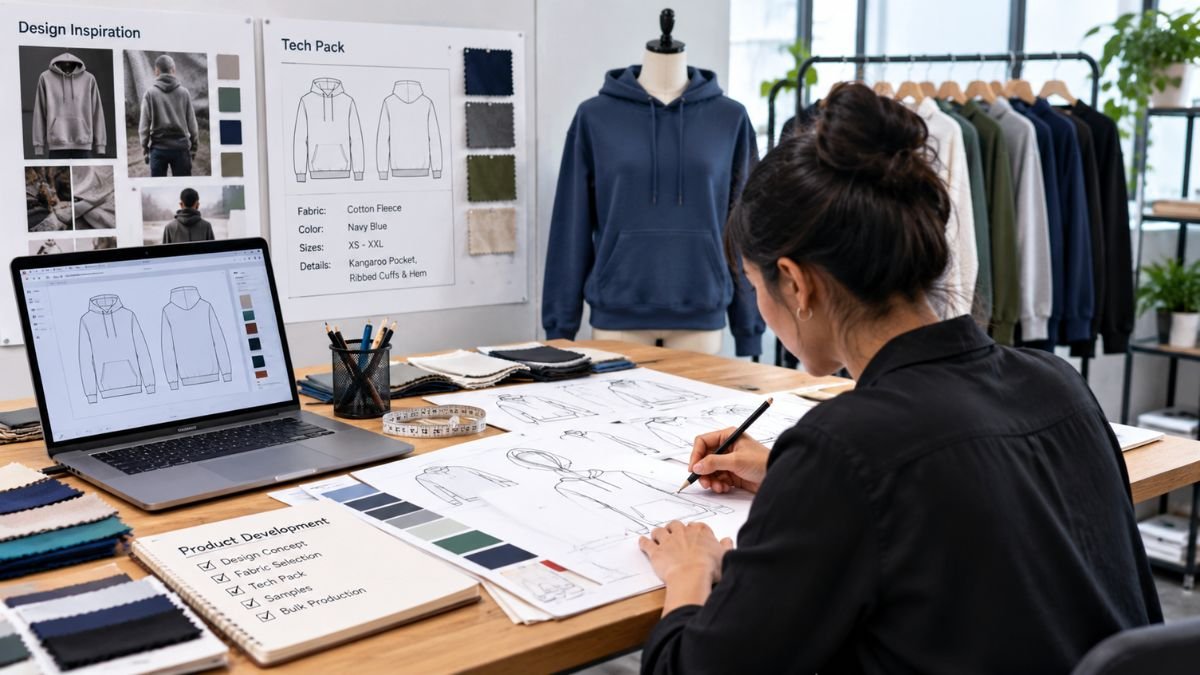
The process begins with a clothing design. A brand decides what it wants to sell, who will wear it, and how the finished garment should look and feel.
Designers create sketches or digital designs that show the garment’s shape, details, colors, and construction. They also choose features such as pockets, collars, buttons, zippers, cuffs, and stitching styles.
Next, the brand prepares a technical package, often called a tech pack. This document contains important manufacturing instructions, including measurements, fabric specifications, color references, labels, and construction details.
A clear tech pack helps the manufacturer understand the product. It also reduces misunderstandings during sampling and bulk production.
2. Fabric and Material Sourcing
Fabric sourcing is another important step in mass clothing production. Manufacturers need suitable materials that match the design, target price, and intended use.
Common clothing materials include cotton, polyester, viscose, denim, nylon, spandex blends, and fleece. Each material has different properties that affect comfort, durability, appearance, and manufacturing requirements.
For example, cotton works well for many everyday T-shirts, while polyester is common in sportswear. Denim requires specialized cutting and finishing processes, whereas stretch fabrics need careful handling to maintain their shape.
Manufacturers may purchase fabric from textile mills or approved suppliers. They also source supporting materials, such as thread, buttons, zippers, elastic, and labels.
Before production begins, the factory checks fabric quality, color consistency, weight, and defects. This inspection helps prevent problems that could affect thousands of finished garments.
3. Pattern Making and Size Grading
Pattern making converts a clothing design into fabric pieces ready for cutting. In this stage, skilled pattern makers create the exact shapes and measurements for each part of the garment.
For example, a T-shirt pattern includes pieces for the front, back, sleeves, and neckline. A pair of trousers requires separate patterns for the legs, waistband, pockets, and other components.
After creating the base pattern, manufacturers use size grading to produce different sizes. Grading adjusts measurements according to the brand’s sizing specifications.
A clothing brand may need sizes XS, S, M, L, and XL. Each size must follow a consistent measurement system so customers receive predictable fits.
Modern factories often use computer-aided design software to create, adjust, and store digital patterns. These tools improve accuracy and help prepare cutting layouts for large production orders.
4. Fabric Spreading and Cutting
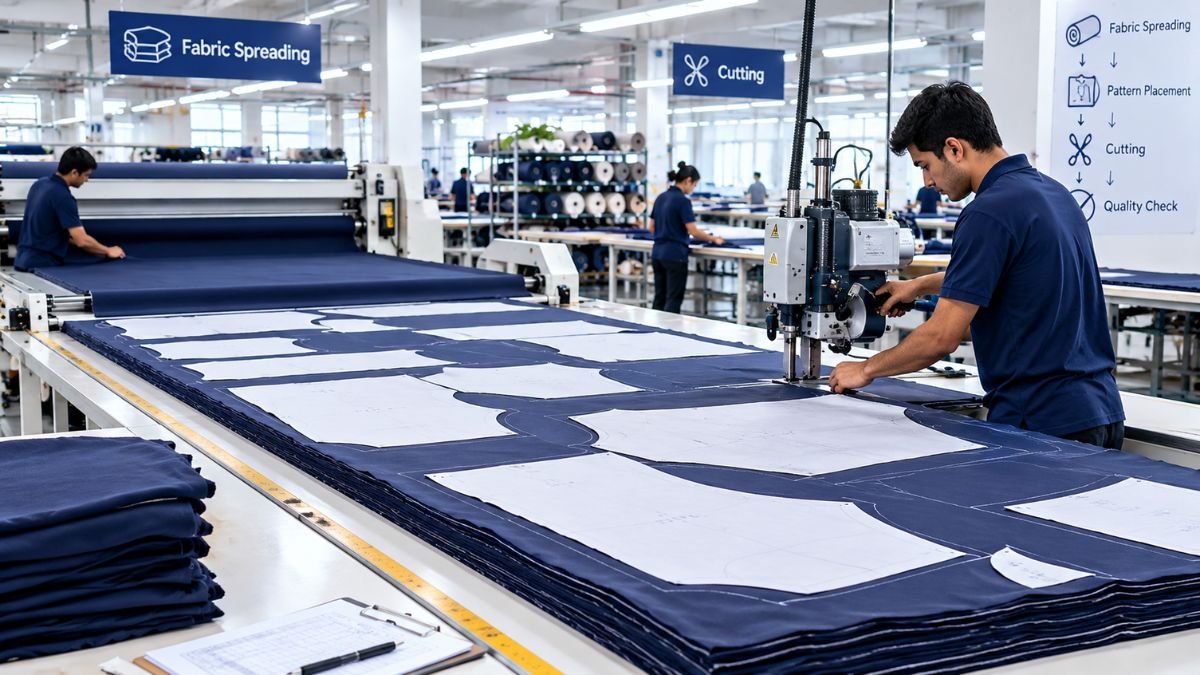
Once the patterns are ready, the factory prepares the fabric for cutting. Workers or automated equipment spread multiple layers of fabric across a long cutting table.
The layers must remain aligned and smooth. Poor fabric spreading can cause uneven pieces, inaccurate measurements, or wasted material.
Next, the manufacturer places the cutting patterns over the fabric layout. Computer software can arrange the pieces to reduce unused space and improve fabric utilization.
Factories may cut fabric using straight knives, band knives, computerized cutting machines, or automated cutting systems. The appropriate method depends on fabric type, order volume, and available equipment.
Cutting multiple layers at once allows factories to prepare hundreds of garment pieces in a single operation. Workers then sort and bundle the pieces according to style, size, color, or production batch.
Accurate cutting is essential because mistakes at this stage can affect garment fit and increase material waste.
5. Sewing and Garment Assembly
Sewing is the stage where individual fabric pieces become complete garments. In mass production, factories organize sewing operations to handle repeated tasks efficiently.
Instead of one worker making an entire garment, several workers may perform different operations. One worker attaches sleeves, another closes side seams, and another adds collars or hems.
Factories use different sewing machines for different operations. These may include lockstitch machines, overlock machines, coverstitch machines, and specialized equipment for buttonholes or attaching buttons.
For example, producing a basic T-shirt may involve joining the shoulder seams, attaching the neckline, setting the sleeves, closing the side seams, and finishing the hem.
The sequence depends on the garment design and factory workflow. Production supervisors organize these tasks to reduce unnecessary movement and prevent bottlenecks.
Efficient sewing operations help manufacturers produce large quantities while maintaining consistent construction and stitching quality.
6. Printing, Embroidery, and Decoration
Many garments need extra decoration before finishing. Clothing brands use printing, embroidery, patches, appliques, and other techniques to create unique products.Brands often use screen printing for repeated designs on T-shirts and sweatshirts. They use direct-to-garment printing for smaller orders or detailed graphics. They also use embroidery to create raised thread designs for logos on caps, polos, and jackets.Heat transfers and sewn patches offer more decoration options. The best method depends on your design, fabric, order quantity, durability, and budget.Factories apply some decorations before sewing because flat fabric panels are easier to handle. They add other decorations after they assemble the garment.Factories must check the placement, look, and durability of every decoration. Incorrect placement or poor print quality can make an otherwise well-made garment unsellable.
7. Garment Finishing and Pressing
After sewing and decoration, garments move to the finishing stage. Workers remove loose threads, inspect seams, and prepare each item for presentation.
Some garments require pressing or steaming to remove wrinkles and improve their appearance. Others may need washing, softening, garment dyeing, or special treatments.
Denim, for example, may undergo washing or abrasion processes to achieve a particular color and texture. Knitwear may require careful steaming to help garments meet the intended measurements.
Finishing requirements depend on the product. A basic cotton T-shirt usually needs fewer treatments than a heavily washed pair of jeans.
Manufacturers also attach care labels, brand labels, size labels, and hangtags according to the customer’s specifications.
Proper finishing helps garments look consistent and ready for retail packaging.
8. Quality Control and Inspection
Quality control helps ensure that mass-produced clothing meets the brand’s requirements. Because factories manufacture many pieces in each order, small problems can become expensive if they go unnoticed.
Manufacturers may inspect materials before cutting, monitor garments during sewing, and examine finished products before shipment.
Common inspection points include:
- Correct measurements and sizing
- Stitching strength and seam construction
- Fabric defects, stains, or holes
- Color consistency and print placement
- Zippers, buttons, and other components
- Label accuracy and garment appearance
Some factories inspect every garment for selected defects, while other checks use sampling plans. The appropriate approach depends on the product, buyer requirements, and quality agreement.
Brands can also request pre-production samples, production samples, and final inspections. These checks help identify issues before the entire order is shipped.
A reliable quality control process reduces returns, customer complaints, and unnecessary production costs.
9. Folding, Packaging, and Shipping
Once garments pass the required inspections, workers prepare them for delivery. Each item may be folded, tagged, placed in a protective bag, or packed directly into a carton.
Packaging instructions depend on the brand’s requirements and sales channel. Products intended for retail stores may need hangtags and barcodes, while e-commerce orders may require specific packaging arrangements.
Factories count garments by size, color, and style before packing them into shipping cartons. Accurate carton information helps brands manage inventory after delivery.
The completed order is then prepared for transportation. Depending on the destination, shipment may travel by road, air, or sea.
International orders may also require customs documents, commercial invoices, packing lists, and other shipping paperwork.
The mass production process is complete when the finished garments are packed and ready for delivery to the brand’s warehouse, distribution center, or other agreed destination.
What Machines Are Used to Mass Produce Clothes?
Clothing factories use a range of machines to speed up manufacturing and improve consistency. The equipment depends on the garment category and the factory’s production capacity.
Common machines include fabric spreading equipment, cutting machines, industrial sewing machines, overlock machines, coverstitch machines, button-attaching machines, embroidery machines, and pressing equipment.
Computer-aided design systems help manufacturers prepare patterns and cutting layouts. Automated cutting systems can improve accuracy and reduce manual work on suitable production runs.
Some factories also use specialized equipment for denim washing, fabric printing, knitting, or garment finishing.
However, not every factory uses the same technology. Smaller manufacturers may rely more heavily on manual processes, while larger facilities may have advanced automated systems.
The best equipment setup depends on product complexity, order volume, available investment, and the level of precision required.
How Much Does Mass Clothing Production Cost?
The cost of mass-producing clothes depends on several factors. There is no single price that applies to every garment because materials, construction, order size, and manufacturing location vary.
Fabric and Material Costs
Fabric is often a major part of a garment’s total manufacturing cost. Premium cotton, heavyweight fleece, technical fabrics, and specialty materials can cost more than basic alternatives.
Trims also affect the final price. Zippers, buttons, custom labels, drawcords, and branded accessories may increase material expenses.
Design and Development Costs
New clothing products may require pattern development, tech packs, samples, and fit revisions before bulk production begins.
Factories sometimes charge these costs separately from the unit price. Complex designs need more development work than simple garments.
Labor and Manufacturing Costs
Labor costs depend on the manufacturing location, production method, garment complexity, and factory efficiency.
A simple T-shirt generally requires fewer operations than a tailored jacket. Additional pockets, panels, embroidery, or special construction can increase sewing time.
Order Quantity
Larger orders can reduce the cost per garment because setup, development, and other fixed expenses may be spread across more units.
However, a large order also requires more upfront capital and creates greater inventory risk. Ordering more clothing does not automatically make a project more profitable.
Printing, Finishing, and Packaging
Custom prints, embroidery, washing treatments, special labels, and premium packaging add to production costs.
Shipping, customs duties, testing, and inspection may also affect the total landed cost.
For accurate budgeting, request a detailed quotation from your manufacturer. Ask which services your manufacturer includes, which services cost extra, and how the price changes with different order quantities.
How to Get Clothes Mass Produced for Your Clothing Brand
If you want to launch a clothing brand, learning how to get clothes mass produced can help you avoid costly mistakes. The process starts with a clear product plan and continues through manufacturer selection, sampling, pricing, and bulk production.
1. Decide What Clothing You Want to Produce
Start by choosing your product category. You might want to manufacture T-shirts, hoodies, jeans, leggings, dresses, uniforms, or sportswear.
Define your target customer, expected retail price, preferred fabric, and design requirements. These details help you find a manufacturer with the right experience.
It is also useful to estimate your initial sales demand. Producing thousands of units before testing your market can leave you with excess inventory.
2. Prepare a Tech Pack
A tech pack explains how your clothing product should be manufactured. It gives the factory clear instructions instead of relying on sketches or verbal descriptions alone.
Include garment measurements, fabric details, colors, stitching requirements, trims, labels, artwork, and packaging instructions. Add reference images where necessary.
If you do not know how to prepare a professional tech pack, consider hiring a technical designer or product development specialist.
A detailed tech pack makes quotations easier to compare and reduces confusion during production.
3. Find a Suitable Clothing Manufacturer
Search for manufacturers that produce your type of clothing. You can use garment industry directories, trade shows, professional networks, referrals, and supplier marketplaces.
Some manufacturers specialize in small clothing brands, while others focus on large wholesale orders. Choose a supplier whose capabilities match your product and expected quantity.
Compare several manufacturers before making a decision. Review their product experience, communication, sample quality, production capacity, and quality control procedures.
If possible, ask for references or examples of similar products they have manufactured.
4. Compare Minimum Order Quantities
A minimum order quantity, or MOQ, is the smallest order a manufacturer is willing to accept under specified terms.
Some factories require large orders, while others accept smaller production runs. The MOQ may apply per style, color, fabric, or size arrangement.
Ask manufacturers to explain their requirements clearly. A supplier may accept a modest total order but require a minimum quantity for each color.
If your budget is limited, look for a manufacturer that offers suitable low-volume production. You can also simplify your design or reduce the number of colors to make the first order more manageable.
5. Request Samples
Always review a sample before approving bulk production. A sample allows you to assess fabric quality, garment fit, stitching, construction, and overall appearance.
You may need several rounds of sampling to correct measurements or adjust details. Although revisions can add time and expense, they can prevent much larger problems later.
Approve the final sample only when it matches your requirements. Keep a record of the approved specifications so the factory can use them as a reference during manufacturing.
6. Request a Detailed Production Quote
Ask each manufacturer for a written quotation based on the same product specifications. This makes it easier to compare suppliers fairly.
Your quotation should explain the unit price, MOQ, sample charges, material costs, customization fees, production timeline, payment terms, and shipping arrangements.
Also ask whether the price includes labels, packaging, inspection, and any required testing.
A very low quotation may exclude important services or use different materials. Compare the full scope of work rather than choosing a factory based only on price.
7. Confirm the Production Timeline
Before placing your order, ask the manufacturer to provide a realistic schedule. Product development, fabric sourcing, sampling, bulk manufacturing, and shipping each require time.
The timeline may change if materials are unavailable, designs need revisions, or production capacity is limited.
Agree on important milestones and ask how the factory communicates delays. Leave enough time for inspection and transportation before your planned launch date.
8. Approve Bulk Production
Once the sample, price, materials, and production terms are approved, the manufacturer can begin bulk production.
Confirm the order quantity, size breakdown, color distribution, delivery destination, and quality standards in writing. Keep all approved specifications and changes documented.
For a new supplier, consider using agreed production checkpoints rather than waiting until the entire order is finished.
Clear communication helps prevent avoidable errors and keeps the project aligned with your expectations.
9. Inspect the Finished Order
Arrange the appropriate quality checks before the garments are shipped. Verify measurements, construction, fabric appearance, decoration, labels, and packaging.
For larger or higher-risk orders, consider an independent inspection service. Agree on the inspection scope and acceptable defect criteria before production starts.
Do not assume that a factory’s internal quality checks automatically meet your brand’s standards. Confirm the requirements and inspection results.
10. Arrange Shipping and Inventory
After the order passes the required checks, confirm the final carton count, shipping method, delivery terms, and paperwork.
International shipping can involve freight charges, insurance, import duties, taxes, and customs clearance. These expenses should be included when calculating your total product cost.
Once the garments arrive, check the shipment against the purchase order and store the products in an organized inventory system.
Good inventory management helps you track sizes, colors, sales, and future restocking needs.
What Should You Look for in a Mass Clothing Manufacturer?
Choosing the right manufacturing partner is one of the most important decisions for a clothing brand. A suitable factory should offer the capabilities, communication, and production standards your business requires.
Relevant experience: Choose a manufacturer familiar with your garment category, fabric, and construction methods.
Consistent quality: Ask how the factory checks materials, measurements, stitching, and finished garments.
Clear communication: Your supplier should respond to questions, explain production requirements, and communicate problems promptly.
Transparent pricing: Request written quotations and confirm which costs are included.
Realistic capacity: Make sure the factory can handle your order without promising a timeline it cannot meet.
Appropriate order quantities: Confirm that the MOQ fits your budget and sales expectations.
Documented agreements: Record specifications, payment terms, delivery dates, inspection requirements, and responsibilities.
Responsible production practices: When relevant, ask about worker safety, labor standards, material traceability, and environmental practices. Request suitable documentation rather than relying only on marketing claims.
A manufacturer should be treated as a long-term business partner. Reliable communication and consistent results often matter as much as the initial unit price.
What Is the Difference Between Mass Production and Small-Batch Clothing Production?
Mass production and small-batch production use many of the same manufacturing steps. The main differences involve order volume, flexibility, cost structure, and inventory risk.
Mass production is designed for larger quantities of standardized products. It may offer lower unit costs when orders are sufficiently large and production is efficient.
Small-batch production involves fewer garments per run. It can be useful for testing designs, launching a new brand, or selling limited collections.
However, small batches may have higher unit costs because setup expenses are divided across fewer products. They can also offer greater flexibility when changing designs or responding to customer feedback.
Neither method is best for every business. Your choice should depend on demand, available capital, product complexity, and your plans for growth.
What Challenges Do Clothing Factories Face During Mass Production?
Large-scale garment manufacturing requires careful coordination. Problems in one stage can delay other stages or affect the quality of the finished order.
Material shortages: Delayed fabric or trim deliveries can interrupt production. Factories reduce this risk through purchasing plans and supplier coordination.
Quality variations: Differences in fabric, cutting, stitching, or measurements can create inconsistent products. Standard specifications and regular inspections help control these issues.
Production bottlenecks: Some operations take longer than others. Supervisors balance workloads and adjust production sequences to maintain efficiency.
Fabric waste: Poor cutting layouts and manufacturing errors increase material use. Better pattern planning and cutting practices can reduce waste.
Changing customer demand: Fashion trends and sales forecasts can change quickly. Brands can reduce risk by testing products before committing to large quantities.
Shipping delays: Transportation disruptions and customs procedures may affect delivery schedules. Businesses should plan for potential delays and confirm shipping arrangements early.
Effective planning helps factories manage these challenges while protecting product quality and delivery commitments.
How Is Technology Changing Mass Clothing Production?
Technology helps modern clothing manufacturers improve speed, accuracy, and production planning.
Computer-aided design software allows designers to create and adjust patterns digitally. Automated cutting systems can cut fabric accurately when the material and production setup are suitable.
Digital production tracking helps managers monitor orders, material usage, and manufacturing progress. Some factories use automated inspection systems to identify selected fabric or garment defects.
Three-dimensional garment design and virtual sampling can also help teams evaluate certain design choices before making physical samples. However, physical samples remain important for checking actual fabric behavior, fit, and construction.
Automation does not remove every manufacturing challenge. Skilled workers, experienced technicians, and effective quality control remain essential.
The most successful factories combine suitable technology with trained people and well-organized processes.
Is Mass-Produced Clothing Sustainable?
Mass-produced clothing can create environmental and social challenges, but its impact depends on how products are designed, manufactured, transported, and used.
Large production runs may improve fabric utilization and reduce certain setup costs. However, producing more clothing than customers need can create unsold inventory and unnecessary waste.
Fabric production, dyeing, finishing, and garment washing may consume water and energy. Some processes also require chemicals that must be handled and managed appropriately.
Brands can take practical steps to improve their manufacturing decisions. These include choosing suitable durable fabrics, planning production around realistic demand, reducing cutting waste, and checking suppliers’ environmental practices.
Better inventory forecasting can help prevent excessive production. Repairable designs and longer-lasting garments may also reduce the need for frequent replacement.
Sustainability claims should be supported by evidence. A material or manufacturing process should not be described as environmentally friendly simply because it uses a natural fiber or modern equipment.
Frequently Asked Questions About How Clothes Are Mass Produced
How are clothes mass produced step by step?
Clothes are mass produced through design, material sourcing, pattern making, fabric cutting, sewing, decoration, finishing, quality control, and packaging. The finished garments are then shipped to the brand or retailer.
How can I get clothes mass produced for my brand?
Prepare your designs and tech packs, find a suitable clothing manufacturer, compare MOQs and quotations, approve samples, and confirm production terms. After bulk manufacturing, arrange quality inspection and shipping.
What is the minimum order quantity for mass-produced clothing?
The MOQ depends on the manufacturer, garment type, fabric, colors, and production method. Some factories accept smaller orders, while others require hundreds or thousands of pieces. Always confirm the MOQ for your exact product.
How long does mass clothing production take?
Production time varies according to order size, design complexity, material availability, and factory capacity. Sampling and fabric sourcing may take additional time before bulk manufacturing begins. Shipping must also be included in the overall schedule.
Is mass-produced clothing cheaper?
Mass production can reduce unit costs by spreading setup expenses across larger quantities. However, large orders require more upfront investment and may increase storage costs or unsold inventory risk.
What types of clothes can be mass produced?
Manufacturers can mass produce T-shirts, hoodies, jeans, trousers, dresses, uniforms, sportswear, underwear, jackets, and many other garment types. Each product requires suitable equipment, materials, and manufacturing skills.
Can a small clothing brand use mass production?
Yes. A small brand can work with a manufacturer that accepts manageable order quantities. Starting with a simpler design and a limited number of colors may help control costs and reduce inventory risk.
Which country is best for mass clothing production?
There is no single best country for every clothing brand. The right location depends on product specialization, pricing, factory capabilities, quality requirements, communication, shipping costs, and import rules.
How do manufacturers maintain clothing quality during mass production?
Manufacturers use approved specifications, material inspections, in-process checks, measurement standards, and final inspections. Brands can also approve samples and arrange independent inspections when necessary.
What costs should I include when mass producing clothes?
Consider development and sampling, fabric, trims, labor, printing, finishing, packaging, quality inspection, shipping, insurance, import duties, and taxes where applicable. These expenses help you calculate the true landed cost.
Conclusion
Mass clothing production turns clothing designs into large quantities of finished garments through a structured manufacturing process. It combines product development, fabric sourcing, pattern making, cutting, sewing, finishing, quality control, and shipping.
For clothing brands, understanding each stage makes it easier to plan budgets, evaluate suppliers, and avoid manufacturing problems. Learning how to get clothes mass produced also helps new businesses make informed decisions about order quantities, samples, pricing, and production timelines.
The best approach is to begin with a clear product specification, choose a suitable manufacturer, approve a sample, and confirm every important detail before bulk production starts. Careful planning can help your clothing brand build consistent products while managing costs and inventory more effectively.