
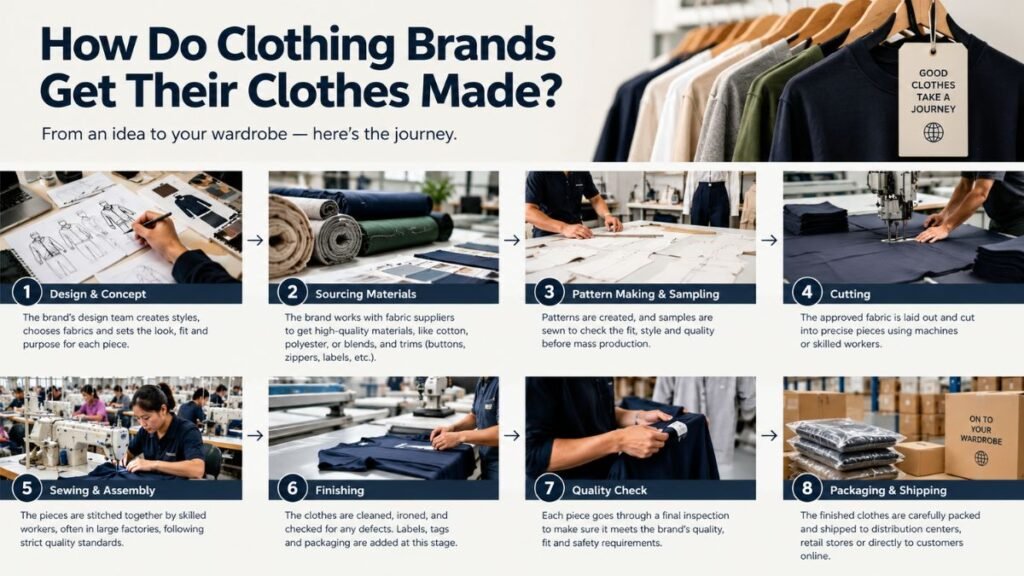
Have you ever wondered how clothing brands turn a simple design idea into the T-shirts, hoodies, jeans, dresses, and uniforms people buy? Behind every finished garment is a process that involves product development, fabric sourcing, sampling, manufacturing, and quality control.
Clothing brands usually get their clothes made by working with clothing manufacturers, garment factories, or private-label suppliers. The brand develops the design and product requirements, while the manufacturing partner helps turn those requirements into physical garments. Some brands use their own factories, while others outsource production to specialized manufacturers.
Understanding how clothing brands get their clothes made can help new entrepreneurs plan a clothing line, choose the right production partner, manage costs, and avoid common manufacturing mistakes.
In this guide, we explain the clothing manufacturing process step by step, from the first design concept to the finished products ready for sale.
How Do Clothing Brands Get Their Clothes Made?
Most clothing brands follow a series of steps to manufacture their products. The exact process depends on the garment type, production budget, customization requirements, and business model.
A typical clothing production process includes:
- Developing a clothing idea and defining the target customer.
- Creating designs and technical specifications.
- Selecting fabrics, trims, and other materials.
- Finding a suitable clothing manufacturer.
- Developing samples and checking the fit.
- Approving the final sample and production details.
- Manufacturing garments in the required quantities.
- Inspecting, labeling, and packaging finished products.
- Shipping the products to a warehouse, retailer, or customer.
Each stage helps turn a creative idea into a product that can be manufactured consistently and sold under a brand’s name.
1. Clothing Brands Start With a Product Idea
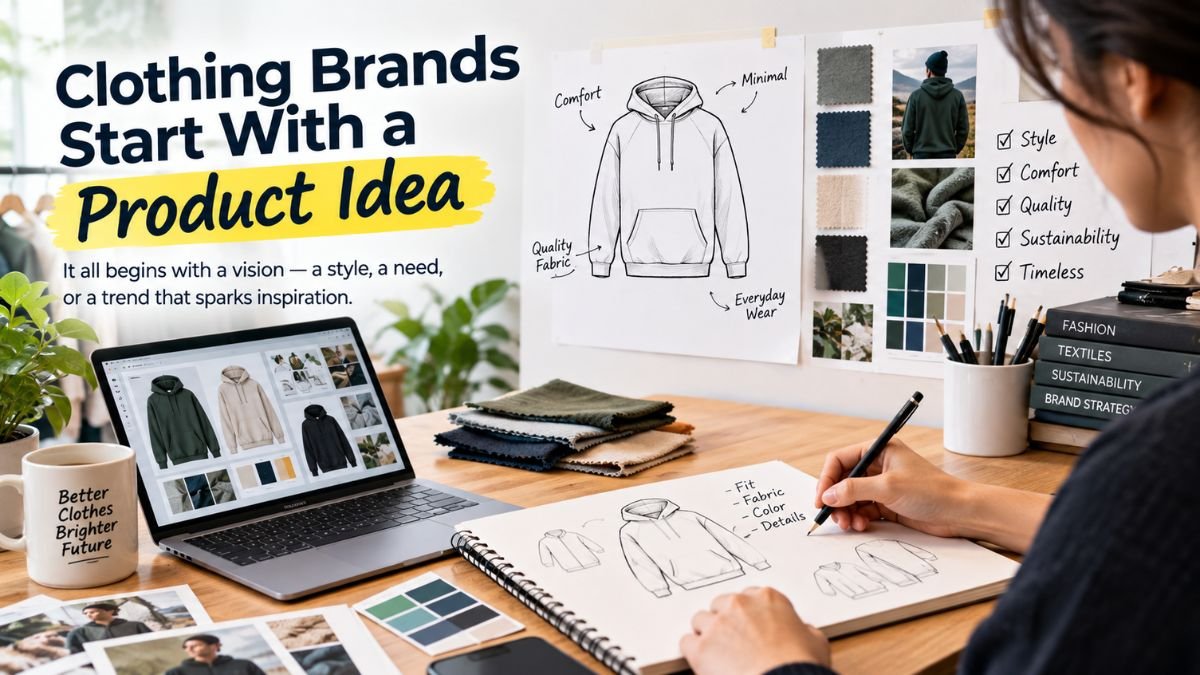
Every clothing manufacturing project begins with an idea. A brand may want to launch basic T-shirts, premium hoodies, activewear, denim, fashion dresses, or workwear for a particular industry.
Before contacting a manufacturer, the brand needs to define what it wants to produce and who will buy it.
For example, a brand developing premium hoodies may need heavyweight fabric, a relaxed fit, ribbed cuffs, a custom logo, and branded labels. A company creating lightweight summer shirts may prioritize breathability, comfort, and a different fabric construction.
At this stage, brands should consider:
- Target audience: Who will wear the clothing?
- Product category: What garments will the collection include?
- Design and fit: What should each item look like and how should it fit?
- Fabric requirements: What material, weight, texture, and performance are needed?
- Target price: What retail price and production budget make sense?
- Brand identity: Will the garments feature custom colors, logos, labels, or packaging?
These decisions help manufacturers understand the project and provide more relevant recommendations and quotations.
2. Designers Create Clothing Designs and Tech Packs
After defining the product idea, the brand develops a design that a manufacturer can interpret accurately.
Designers may begin with hand-drawn sketches, digital illustrations , reference photographs, or an existing garment. However, a visual design alone may not contain enough information for accurate manufacturing.
This is where a clothing tech pack becomes important.
A tech pack is a technical document that communicates how a garment should be made. It reduces ambiguity by recording the product’s measurements, materials, construction details, and customization requirements.
A typical clothing tech pack may include:
- Front, back, and detail drawings.
- Fabric composition and weight.
- Garment measurements and size specifications.
- Stitching and seam construction details.
- Color references.
- Buttons, zippers, drawstrings, and other trims.
- Logo placement and artwork instructions.
- Label and packaging requirements.
- Special finishing or washing instructions.
For example, a T-shirt tech pack might specify the body length, chest width, sleeve length, neckline construction, fabric composition, and location of a printed logo.
Clear specifications make it easier for a manufacturer to estimate costs, develop samples, and reproduce the approved design during bulk production.
3. Clothing Brands Source the Right Fabrics and Materials
Fabric selection is one of the most important decisions in the clothing manufacturing process. The material affects a garment’s appearance, comfort, durability, fit, care requirements, and overall cost.
Clothing brands can source materials through their manufacturing partners or work with separate fabric suppliers, depending on the production arrangement.
Common materials include cotton, polyester, linen, denim, fleece, jersey, and blended fabrics. The right option depends on the garment’s intended use rather than simply choosing the cheapest available material.
For example:
- Cotton: Often selected for its familiar feel and versatility.
- Polyester: Used in many garments where synthetic-fiber properties are useful.
- Cotton-polyester blends: Can combine properties of both fibers, depending on the blend and construction.
- Jersey knit: Commonly used for T-shirts and other knit garments.
- Fleece: Often used for sweatshirts, hoodies, and warm casual clothing.
- Denim: Used for jeans, jackets, and other structured casual garments.
Brands should also consider fabric weight, weave or knit structure, stretch, color consistency, shrinkage, and performance after laundering.
Before approving a material, ask the manufacturer for relevant fabric specifications and samples. If a particular color, finish, or material performance is essential, document the requirement rather than relying on a verbal description.
4. Brands Find a Clothing Manufacturer

Once the product requirements are clear, the brand needs to decide who will manufacture the garments.
Many clothing brands work with third-party manufacturers because operating a factory requires equipment, skilled workers, production management, and other resources. Outsourcing allows brands to focus more on design, marketing, sales, and customer relationships.
However, not every manufacturer is suitable for every project. Some specialize in basic apparel, while others focus on sportswear, denim, outerwear, uniforms, or more complex custom garments.
Where Can Clothing Brands Find Manufacturers?
Brands can explore several sourcing options:
Clothing manufacturing companies: These businesses produce garments according to agreed specifications. Their services may include sampling, material sourcing, cutting, sewing, finishing, and packaging.
Private-label manufacturers: These suppliers help brands sell garments under their own brand identity. Depending on the arrangement, the products may be based on existing styles or developed with custom details.
Cut-and-sew manufacturers: These manufacturers create garments by cutting fabric into pattern pieces and sewing those pieces together. This option is often useful when a brand needs a custom fit, shape, or construction.
Local garment factories: Working with a nearby factory may make communication, sample reviews, and visits easier, depending on the location and supplier.
International manufacturers: Brands may source overseas when a manufacturer offers suitable expertise, materials, pricing, or production capabilities. However, shipping, customs, communication, and lead times must be considered.
How Should Brands Choose the Right Manufacturer?
Before placing an order, brands should ask manufacturers:
- Have you manufactured this type of garment before?
- Can you work with the required fabric and construction?
- Do you offer sample development?
- What is your minimum order quantity?
- What is included in the quotation?
- Can you provide a clear production schedule?
- How do you handle quality checks and defective products?
- Can you meet the required labeling and packaging specifications?
- Which services are handled in-house, and which are outsourced?
Compare manufacturers using the same specifications so their quotations are easier to evaluate.
The lowest quoted price is not automatically the best choice. Fabric quality, construction, communication, consistency, delivery terms, and the full cost of receiving the goods also matter.
5. Manufacturers Develop Samples Before Bulk Production
Before producing hundreds or thousands of garments, brands commonly request a sample to evaluate the design and manufacturing approach.
A sample is a physical version of the proposed product. It helps the brand check whether the garment matches the intended design and whether changes are needed before larger quantities are produced.
Depending on the project, sampling may involve several stages.
Prototype Sample
An initial prototype helps establish the garment’s general shape, construction, and appearance. It may reveal technical issues that need to be resolved.
Fit Sample
A fit sample helps the brand evaluate measurements, proportions, comfort, and movement. Designers can request changes to sleeve length, body width, neckline, rise, or other dimensions.
Revised Sample
If the first sample does not meet the requirements, the manufacturer may prepare a revised version. The brand should document the changes so the next sample reflects the correct specifications.
Pre-Production Sample
A pre-production sample is used to confirm the agreed design and production details before the main order begins. The exact sampling process varies by manufacturer and garment type.
Brands should not approve bulk production until the important product details have been reviewed and agreed upon. This includes fabric, color, measurements, construction, decoration, and branding.
For example, a hoodie may look correct in a photograph but still have sleeves that are too long, fabric that is too thin, or embroidery positioned incorrectly. Reviewing a physical sample helps identify these problems before they affect a larger order.
6. Brands Confirm Costs and Minimum Order Quantities
Once the manufacturer understands the product requirements, the brand can evaluate the quotation and decide how many garments to order.
A manufacturing quotation may include different combinations of materials, labor, decoration, labels, packaging, and other production costs. Brands need to check exactly what is included.
What Affects Clothing Manufacturing Costs?
The cost of producing a garment depends on several factors:
- Fabric type, weight, and consumption.
- Garment design and construction complexity.
- Order quantity.
- Printing, embroidery, and other customization.
- Buttons, zippers, labels, and other accessories.
- Sample development and pattern-making requirements.
- Quality checks, special finishes, and packaging.
- Shipping, duties, and other applicable charges.
A simple T-shirt and a fully customized technical jacket will not have the same production requirements. Even two hoodies can have different costs if their fabrics, stitching, trims, or decoration methods differ.
What Is a Minimum Order Quantity?
A minimum order quantity (MOQ) is the smallest quantity a supplier agrees to produce for a particular order or product arrangement.
The MOQ varies by manufacturer, garment, fabric, customization, and production setup. Some suppliers accept smaller orders, while others require larger quantities.
Before ordering, ask whether the minimum applies per style, color, size, or total order. Also confirm whether different sizes and colors can be combined.
For a new brand, ordering a manageable quantity may help limit unsold inventory. However, smaller orders can sometimes have higher per-unit costs because material purchases and setup costs are spread across fewer garments.
The right quantity balances the manufacturer’s requirements with the brand’s budget, sales expectations, and inventory risk.
7. The Manufacturer Begins Bulk Clothing Production
After the brand approves the sample, materials, specifications, pricing, and order details, the manufacturer can prepare for bulk production.
The precise production sequence varies by garment type and factory, but the main stages generally include material preparation, cutting, sewing, decoration, and finishing.
Fabric Inspection and Preparation
The production team checks incoming materials against the agreed requirements. Depending on the fabric and process, preparation may include inspecting the material, relaxing it before cutting, or preparing it for a particular finish.
Problems such as inconsistent colors, defects, or unexpected shrinkage may need to be addressed before production continues.
Pattern Making and Fabric Cutting
Patterns define the shapes and dimensions of the garment pieces. Manufacturers use these patterns to plan and cut the required components.
Efficient cutting arrangements can help control fabric waste while maintaining the required piece dimensions. Accuracy matters because cutting errors can affect the fit and assembly of the finished garment.
Sewing and Garment Assembly
The cut fabric pieces move through the sewing process, where workers or specialized machines join the components.
For a basic T-shirt, this may involve assembling the shoulders, attaching the sleeves, closing the side seams, and finishing the neckline and hems.
A jacket, pair of jeans, or technical garment may require more complicated construction, additional components, and specialized operations.
Printing, Embroidery, and Customization
Brands often add their identity through printed artwork, embroidery, woven labels, patches, or other decorative details.
The method should match the artwork, fabric, intended appearance, and durability requirements. Placement and color should be checked against the approved specifications.
Finishing
Finishing prepares garments for inspection and presentation. Depending on the product, it may include trimming loose threads, pressing, washing, applying approved treatments, or checking final appearance.
These operations help bring the garment closer to its approved finished condition.
8. Quality Control Checks the Finished Garments
Quality control is essential because the finished garments need to match the agreed specifications closely enough for the brand’s requirements.
A manufacturer and brand should agree on the relevant checks before production begins. The inspection plan depends on the garment, order size, product risks, and any applicable requirements.
Typical checks may include:
- Measurements and size consistency.
- Fabric color and visible defects.
- Seam quality and stitching.
- Zipper, button, and closure function.
- Print or embroidery placement.
- Label accuracy and placement.
- Overall appearance and finishing.
- Packaging and quantity verification.
Brands should also clarify how defects will be documented and handled, including who pays for rework or replacement when the agreed requirements are not met.
Quality should not be considered only at the end. Checking materials, samples, and production stages can help identify problems earlier, when corrections may be easier to manage.
For products that make specific safety or performance claims, ordinary visual inspection is not enough to prove compliance. Relevant product testing, documentation, or certification may be required.
9. Clothing Brands Add Labels, Tags, and Packaging
Once garments pass the agreed checks, they are prepared for sale or distribution.
Branding and packaging requirements should be defined before production, not left until the final stage. Depending on the product, these details may include:
- Main brand labels.
- Size labels.
- Care labels.
- Hang tags.
- Product barcodes or identification labels.
- Individual polybags or alternative packaging.
- Carton markings and packing lists.
Labeling requirements depend on the destination market and product type. For example, the U.S. Federal Trade Commission explains requirements relating to textile fiber content, country of origin, responsible business identity, and care instructions for covered products. Brands selling internationally should verify the applicable rules for each market.
Official reference: FTC Apparel and Labeling Guidance.
Packaging also affects how products are stored, transported, and presented to customers. A brand should confirm quantities per package, size assortments, labeling details, and carton requirements with its manufacturer.
10. Finished Clothing Is Shipped to the Brand
After production, inspection, and packaging, the garments are prepared for shipment.
Depending on the business arrangement, products may be sent to the brand’s warehouse, a distribution center, a retail partner, or another agreed destination.
Shipping arrangements can involve road, air, or sea transport, depending on the route, urgency, cost, and order size.
Before the goods leave the manufacturer, the brand should confirm:
- The approved order quantity.
- The packing list and carton details.
- The shipping method and delivery terms.
- The destination and receiving arrangements.
- Any required export, import, or customs documentation.
- The handling of shortages, damage, or discrepancies.
The quoted manufacturing price may not include freight, insurance, customs duties, or other costs associated with delivery. Brands should review the complete arrangement rather than compare factory prices alone.
Once the garments arrive, the brand can check the shipment against the order and prepare the inventory for sale.
What Are the Different Ways Clothing Brands Get Their Clothes Made?
Not every clothing brand uses the same production model. The best option depends on how much customization the brand needs and how much product development it can manage.
| Manufacturing model | How it works | Best suited for |
|---|---|---|
| Private-label clothing | Existing or developed garments are sold under a brand’s identity, depending on the supplier’s services. | Brands seeking branded products without managing every manufacturing stage themselves. |
| Cut-and-sew manufacturing | Fabric is cut into pattern pieces and sewn into the specified garment. | Brands requiring custom designs, fits, and construction. |
| Custom clothing manufacturing | A supplier develops products to agreed design and technical requirements. | Brands seeking distinctive garments or specific features. |
| Ready-made or blank apparel | Existing garments are purchased and may be decorated or branded where permitted. | Brands testing products or using simpler designs. |
| In-house production | The brand manages manufacturing through its own production facility or team. | Businesses that need direct control over production and have the resources to operate it. |
These models can overlap. For example, a private-label supplier may also offer custom cut-and-sew production. Brands should ask what the supplier actually provides rather than relying on the model’s name alone.
How Much Does It Cost to Get Clothing Manufactured?
There is no single price for manufacturing clothing. The cost depends on the garment, materials, quantity, construction, customization, and delivery arrangement.
A basic garment made from readily available materials may have a very different cost from a custom jacket with specialized hardware, multiple panels, and detailed embroidery.
To obtain a useful quotation, provide the manufacturer with:
- A clear design or reference garment.
- A tech pack or detailed product specifications.
- Fabric and trim requirements.
- The required sizes and colorways.
- The estimated order quantity.
- Printing, embroidery, labeling, and packaging details.
- The delivery destination and preferred shipping terms.
Ask the supplier to identify any excluded costs, sample charges, payment terms, and conditions that could change the final price.
Comparing quotations based on the same specifications gives brands a clearer picture of value. A lower initial price may not be better if it excludes important services or uses materials that do not meet the product requirements.
How Long Does Clothing Manufacturing Take?
The production timeline varies by product complexity, sampling requirements, material availability, order quantity, and the manufacturer’s current workload.
A project that uses available fabric and a straightforward design may require less development than a garment with custom materials, multiple sample revisions, special finishes, or complex construction.
The timeline can include:
- Design and technical specification development.
- Fabric and trim sourcing.
- Pattern making and sample development.
- Fit review and revisions.
- Pre-production approval.
- Bulk manufacturing and quality checks.
- Packing and shipping.
Brands should ask for a project-specific schedule that identifies major milestones and approval deadlines. They should also allow time for revisions and transportation rather than assuming production ends when sewing is complete.
Clear communication and prompt sample approvals can help reduce avoidable delays.
Common Mistakes to Avoid When Working With Clothing Manufacturers
A good manufacturing plan addresses potential problems before they affect the finished products.
1. Starting Without Clear Specifications
A vague design brief can lead to misunderstandings about fabric, measurements, construction, and branding. Provide written specifications and reference images wherever possible.
2. Skipping Sample Approval
Moving directly into bulk production without reviewing an appropriate sample increases the risk of receiving garments that do not meet expectations.
3. Choosing a Manufacturer Based Only on Price
A quotation should be evaluated alongside product expertise, communication, quality requirements, production arrangements, and delivery terms.
4. Ignoring Fabric Quality
A fabric’s appearance alone does not tell the whole story. Check the properties that matter for the intended garment, including weight, composition, feel, shrinkage, and care requirements.
5. Failing to Confirm the MOQ
Brands should understand whether minimum quantities apply to each style, color, or size range before committing to an order.
6. Making Last-Minute Design Changes
Changes after sample approval can affect material purchases, production planning, costs, and delivery dates. Record revisions and confirm their impact with the manufacturer.
7. Overlooking Labels and Packaging
Incorrect sizes, care information, logos, or carton details can create problems after manufacturing is complete. Approve these requirements as part of the production specification.
8. Underestimating the Total Cost
Budget for the full order, including samples, production, packaging, transport, and applicable import charges—not just the quoted cost per garment.
How Negora Fist Fits Into the Clothing Manufacturing Process
For brands and businesses sourcing workwear or uniforms, choosing a manufacturer involves more than finding a factory that can sew garments. Product specifications need to reflect how the clothing will be worn, the tasks it must support, and the conditions in which it will be used.
Negora Fist is a workwear manufacturing company with 10 years of workwear manufacturing experience. This experience is relevant to buyers who need to think carefully about garment construction, fabric selection, fit, functional details, branding, and consistency across repeat orders.
When planning a workwear order, buyers should define the intended use, required garment types, material specifications, measurements, functional features, and customization requirements before production begins.
They should also confirm the manufacturer’s current product capabilities, available customization options, minimum quantities, sample arrangements, and quality-control process directly with the company.
If your project involves workwear or uniforms, visit Negora Fist to learn more about the company and explore whether its manufacturing services fit your requirements.
Frequently Asked Questions
1. How do clothing brands get their clothes made?
Clothing brands typically develop a design, prepare technical specifications, source materials, select a manufacturer, approve samples, and place a production order. The manufacturer then produces the garments, checks quality, applies agreed labels and packaging, and prepares the order for shipment.
2. Do clothing brands make their own clothes?
Some brands operate their own production facilities, but many work with third-party clothing manufacturers. Outsourcing can give brands access to specialized production equipment and skills without requiring them to operate a factory themselves.
3. How do I find a clothing manufacturer for my brand?
Start by defining your product, preparing a design brief or tech pack, and identifying manufacturers that work with your garment category. Compare their capabilities, quotations, sample processes, minimum order quantities, communication, and quality requirements before choosing a supplier.
4. What is a tech pack in clothing manufacturing?
A tech pack is a technical document that explains how a garment should be produced. It commonly includes drawings, measurements, materials, construction details, colors, trims, branding instructions, and other specifications needed to develop and manufacture the product.
5. Can a new clothing brand work with a manufacturer?
Yes, depending on the manufacturer’s requirements and capabilities. New brands should prepare a clear product brief, establish a realistic budget, ask about minimum order quantities, and confirm whether sample development and smaller production runs are available.
6. What is private-label clothing manufacturing?
Private-label manufacturing allows a brand to sell clothing under its own brand identity. Depending on the supplier, the service may involve selecting existing garments, adding labels and branding, or developing customized products.
7. What is cut-and-sew manufacturing?
Cut-and-sew manufacturing involves cutting fabric into pattern pieces and sewing those pieces together to create a garment. It is commonly used when a brand needs a particular fit, silhouette, construction, or combination of design details.
8. How can brands maintain clothing quality?
Brands should document product specifications, approve samples, confirm material requirements, agree on inspection criteria, and check finished garments against the approved requirements. Product-specific testing may also be necessary when performance or safety claims are involved.
9. What affects the minimum order quantity for clothing?
The MOQ depends on the manufacturer, garment type, material availability, production setup, and customization requirements. Brands should ask whether the minimum applies to the entire order or separately to each style, color, and size arrangement.
10. How much money do I need to start a clothing brand?
The budget depends on the number of products, sampling and development costs, manufacturing quantities, branding, packaging, shipping, marketing, and other business expenses. Request quotations based on a realistic product plan before deciding how much inventory to purchase.
Final Thoughts
Understanding how clothing brands get their clothes made helps entrepreneurs make better decisions before investing in a new collection. The process starts with a clear product idea and continues through technical specifications, material sourcing, manufacturer selection, sampling, bulk production, quality control, and delivery.
The most important step is to establish clear expectations before production begins. A well-prepared tech pack, an approved sample, a transparent quotation, and agreed quality requirements can help reduce misunderstandings and improve consistency.
Whether you are launching your first clothing line or expanding an established brand, choose a manufacturing partner that understands your product requirements and can explain its capabilities clearly. Careful planning creates a stronger foundation for producing garments that meet your brand’s expectations.