
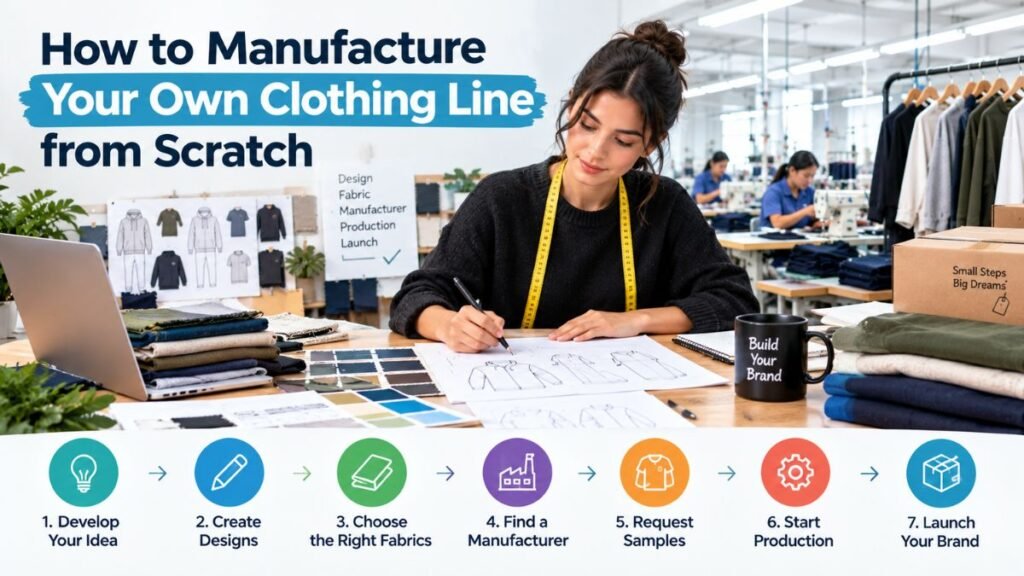
Starting a clothing brand can be an exciting business opportunity. However, turning your ideas into finished garments requires careful planning. You need to develop designs, select fabrics, find a reliable manufacturer, and manage production costs.
Many beginners struggle with the manufacturing process. They may have creative ideas but lack experience working with garment factories. Understanding each step can make the process easier and reduce costly mistakes.
Learning how to manufacture your own clothing line from scratch starts with a clear business plan. You must understand your target customers, product requirements, budget, and production goals. These decisions will guide you through every stage of manufacturing.
You do not need to own a factory to launch a clothing brand. Many businesses work with established clothing manufacturers that produce garments according to their specifications. This approach allows brands to focus on design, marketing, sales, and customer relationships.
This guide explains how to develop your clothing line from the first idea to finished products. You will learn how to choose fabrics, create samples, find garment manufacturers, calculate costs, and prepare for bulk production.
What Does It Mean to Manufacture Your Own Clothing Line from Scratch?
Manufacturing your own clothing line means creating garments that reflect your brand’s designs, quality standards, and identity. You decide what products to sell and how they should look and perform.
You may develop original designs or adapt existing garment concepts to suit your customers. Your manufacturing partner then helps turn those ideas into physical products.
The process can include several stages:
- Researching your target market and competitors
- Developing clothing designs and technical specifications
- Selecting fabrics, colors, and accessories
- Finding suitable clothing manufacturers
- Creating and approving samples
- Producing garments in bulk
- Inspecting quality and preparing products for sale
You can manage these steps yourself or hire specialists to handle specific tasks. Some manufacturers offer complete product development services, while others focus mainly on cutting, sewing, and finishing.
Your approach depends on your budget, experience, and product requirements.
For example, a beginner launching a basic T-shirt brand may need a simpler process than someone developing technical sportswear. Complex garments often require specialized fabrics, construction methods, and testing.
Understanding your needs before production begins helps you choose the right manufacturing model.
1. Define Your Clothing Brand Idea
The first step is deciding what kind of clothing brand you want to build. A clear concept helps you develop products that appeal to a specific audience.
Start by choosing your clothing category. You might focus on streetwear, casual clothing, activewear, formalwear, children’s clothing, or workwear.
Avoid trying to serve every customer at the beginning. A focused product range can make design, sourcing, and manufacturing easier to manage.
Next, define your brand identity. Consider the style, values, and benefits you want your clothing to communicate.
For example, your brand might focus on minimalist designs, comfortable everyday clothing, premium materials, or affordable streetwear. These choices influence your product designs and marketing strategy.
Think about your ideal customer, too. Consider their age range, lifestyle, spending habits, clothing preferences, and shopping behavior.
Research competing brands to understand the products already available. Look for gaps in quality, fit, style, or customer experience that your brand could address.
Your goal is not simply to copy successful competitors. Instead, identify what customers value and develop a distinct product offering.
Once your concept is clear, write a short brand brief. Include your target audience, product category, expected price range, and visual direction.
This document will help guide your design and manufacturing decisions.
2. Research Your Market Before Manufacturing
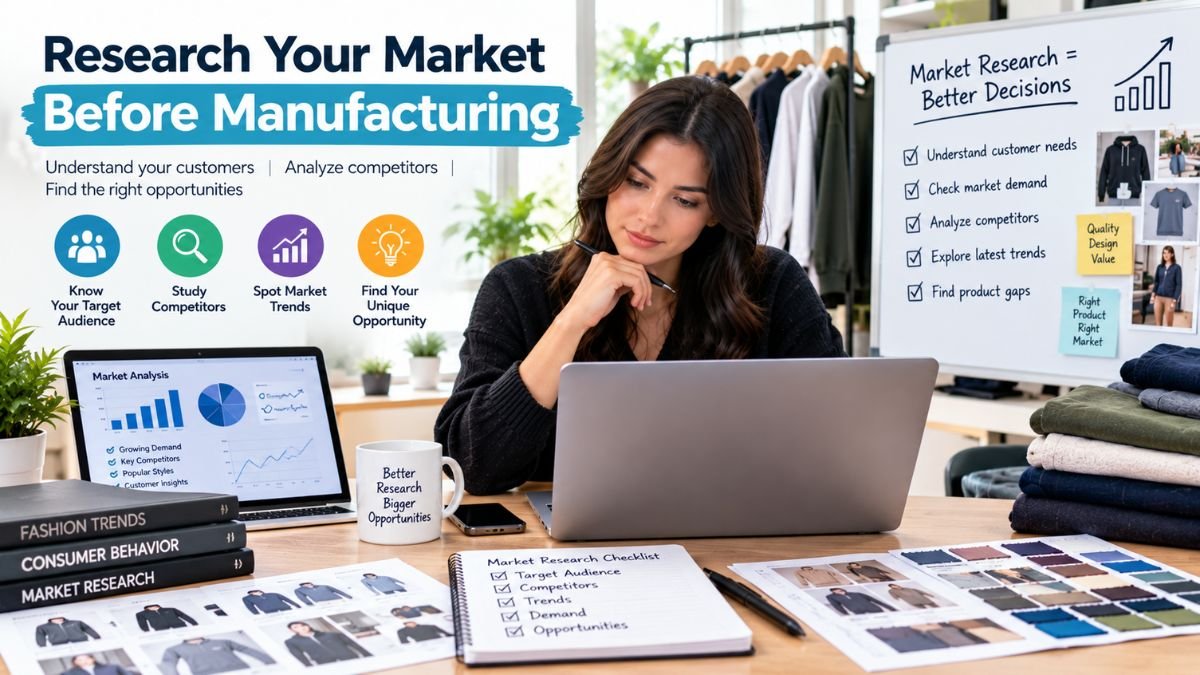
Market research helps you understand whether customers are likely to buy your products. It also helps you avoid investing too much money in clothing that may not sell.
Start by reviewing brands that serve a similar audience. Study their product ranges, prices, materials, sizing, and customer reviews.
Look for recurring complaints. Customers may mention poor stitching, uncomfortable fabrics, inconsistent sizing, or limited color options. These observations can reveal opportunities for your brand.
You can also research social media discussions and online fashion communities. Pay attention to the styles customers discuss and the problems they want brands to solve.
Where possible, speak directly with potential customers. Ask about their preferred clothing styles, budgets, fit requirements, and buying habits.
Use this information to select your first products. A small collection of well-developed garments may be easier to manage than a large collection with many different styles.
For example, a new streetwear brand could begin with two T-shirt designs and one hoodie. This approach limits the number of samples, materials, and production requirements.
Market research cannot guarantee sales. However, it gives you a stronger basis for choosing products and setting prices.
3. Create Your Clothing Designs
Once you understand your market, start developing your clothing designs. These designs communicate how your garments should look and function.
You can create designs using professional software, hand-drawn sketches, or digital illustrations. If you lack design experience, consider working with a freelance fashion designer.
Your designs should show important details, including the garment shape, fit, neckline, sleeves, pockets, closures, and decorative elements.
Color choices also matter. Select colors that match your brand identity and work well with your intended fabrics.
Consider practical details during the design stage. A design may look attractive but prove expensive or difficult to manufacture.
Complex stitching, unusual panels, specialized trims, and detailed embroidery can increase production costs. Simpler designs may be more suitable for a first collection.
Prepare front, back, and side views when needed. Include close-up illustrations of unique features, such as logos, seams, and pockets.
You should also identify the materials and construction methods you expect to use.
Clear designs help manufacturers understand your requirements. They also reduce the risk of misunderstandings during sampling and production.
4. Develop a Technical Pack for Your Clothing Line
A technical pack, often called a tech pack, is a document that explains how a garment should be manufactured. It helps translate your creative ideas into production instructions.
A detailed technical pack can save time by reducing repeated questions and design misunderstandings.
Your technical pack should include the information relevant to your product.
Important details may include:
- Technical sketches showing the garment from different angles
- Fabric composition, weight, and color
- Garment measurements and size specifications
- Stitching, seams, and construction instructions
- Logo placement and artwork details
- Buttons, zippers, labels, and other trims
- Packaging requirements and finishing instructions
For example, if you are manufacturing a cotton T-shirt, specify the fabric composition, desired weight, fit, neckline, sleeve length, and stitching details.
Avoid relying only on general descriptions such as premium fabric or oversized fit. These terms can mean different things to different manufacturers.
Include measurable specifications wherever possible. Use reference images when a feature is difficult to explain through text.
A technical pack may evolve during sampling. Update it whenever you approve a change to the design, measurements, or materials.
The final approved version should guide bulk production.
5. Choose the Right Fabrics for Your Clothing Line
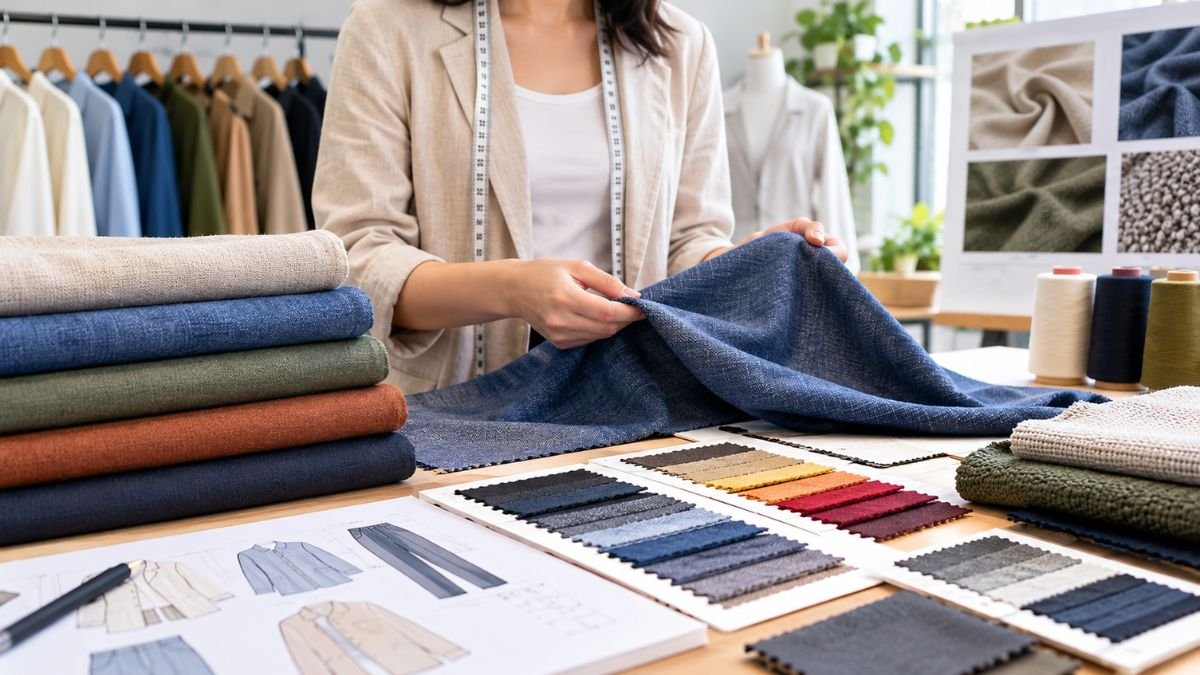
Fabric selection affects comfort, appearance, durability, manufacturing costs, and customer satisfaction. The right material depends on your product category and intended use.
For example, cotton is commonly used for everyday T-shirts and casual garments. Cotton-polyester blends may provide different durability and care characteristics.
Fleece fabrics are popular for hoodies and sweatshirts. Polyester and specialized blends are often used in performance clothing because they can offer useful moisture-management properties.
Denim requires different fabric specifications and construction methods than lightweight woven shirts.
Before selecting a material, consider its weight, texture, stretch, breathability, opacity, and care requirements.
You should also understand how the fabric behaves during cutting, sewing, washing, and finishing.
Request fabric swatches from potential suppliers. Compare their appearance and feel before choosing a material for your samples.
For important products, ask about relevant testing. Shrinkage, colorfastness, pilling, and seam performance may affect the finished garment’s quality.
Confirm whether your manufacturer can source the selected fabric consistently. A material that becomes unavailable may delay future production.
If your brand makes sustainability claims, request suitable documentation to support those claims.
Careful fabric selection helps create products that meet your customers’ expectations.
6. Decide How to Get a Clothing Line Manufactured
Choosing a manufacturing model is an important business decision. Your options affect costs, creative control, production flexibility, and the amount of work you manage yourself.
There are several common ways to manufacture clothing.
Work With a Full-Service Clothing Manufacturer
A full-service manufacturer may help with fabric sourcing, pattern development, sampling, garment production, labeling, and packaging.
This option can simplify the process if you want one partner to manage several stages.
However, services differ between companies. Confirm exactly what the manufacturer provides before signing an agreement.
Use a Cut-and-Sew Manufacturer
A cut-and-sew manufacturer produces garments by cutting fabric panels and sewing them together.
This approach can suit brands that need custom designs, original patterns, and specific construction details.
You may need to provide the fabric, technical pack, or approved pattern, depending on the factory’s services.
Choose a Private-Label Manufacturer
Private-label manufacturers produce garments that can be sold under your brand name.
Some offer existing garment styles with customization options. These may include labels, colors, prints, and selected design changes.
Private-label production can be useful when you want to launch a brand without developing every garment entirely from scratch.
Consider Made-to-Order Production
Made-to-order production involves making garments after customers place orders.
Depending on the product and supplier, this approach can reduce the need to hold large amounts of finished inventory.
However, it may involve longer delivery times or higher production costs per item. It also requires reliable order management.
Choose the model that best matches your product requirements, budget, and expected demand.
7. Find a Reliable Clothing Manufacturer
Finding a suitable factory is one of the most important steps in manufacturing your own clothing line from scratch.
You need a partner that understands your products, meets your quality standards, and communicates clearly.
Start by searching online for manufacturers that specialize in your clothing category. Specific searches can produce more relevant results than general terms.
Useful searches include:
- Custom clothing manufacturers
- Cut-and-sew manufacturers
- Clothing manufacturers for startups
- Private-label garment manufacturers
- Small-batch clothing factories
- Streetwear manufacturing companies
- Activewear manufacturers
You can also explore B2B marketplaces, textile trade shows, industry directories, and professional referrals.
Review each manufacturer’s website and product portfolio. Look for experience with garments similar to yours.
Ask whether the company owns its production facility or outsources manufacturing. Either arrangement may work, but you should understand who will produce your order.
Contact several potential suppliers instead of choosing the first company you find.
Provide the same product requirements to each supplier. This makes quotations easier to compare.
A useful initial inquiry should explain your product type, estimated quantity, fabric preferences, customization requirements, and target delivery date.
Ask about minimum order quantities, sample costs, production capacity, and payment terms.
Do not choose a manufacturer based only on a low quotation. Quality, reliability, and communication also affect your total business costs.
8. Compare Local and Overseas Manufacturers
You may choose a manufacturer in your own country or work with an overseas factory. Each option has potential advantages.
Local manufacturing can make communication, factory visits, and sample reviews easier. It may also help you manage urgent changes.
However, pricing and product availability vary by location. Some local factories may have limited equipment or minimum order requirements.
Overseas manufacturing can provide access to specialized production facilities, different material suppliers, and established garment industries.
However, international production may involve shipping expenses, customs procedures, import duties, and longer lead times.
Compare the complete cost of each option rather than looking only at the factory’s quoted price.
Ask manufacturers about their experience with international clients if you plan to import products.
Confirm shipping responsibilities, delivery terms, and the documents required for your order.
You should also consider communication across different time zones and how the factory handles quality problems.
The best manufacturer is the one that fits your business requirements. A nearby factory is not automatically better, and an overseas factory is not automatically cheaper.
Evaluate both options carefully before making your decision.
9. Understand Minimum Order Quantities
Minimum order quantity, or MOQ, refers to the smallest order a manufacturer accepts under specified conditions.
This requirement can significantly affect your starting budget.
Some factories specialize in large production runs. Others accept small orders from new brands.
The MOQ may apply to each garment style, color, or fabric rather than your entire order.
For example, a manufacturer might accept several hundred basic T-shirts but require a larger commitment for custom-dyed fabric or specialized jackets.
Always ask how the MOQ is calculated.
If you have a limited budget, consider starting with simpler garments and readily available fabrics. These choices may offer more flexibility than complex custom products.
You can also ask whether the manufacturer offers a paid development sample or a small pilot order.
Remember that smaller orders often have higher unit costs. The factory must cover setup and production expenses across fewer garments.
Balance your need for low costs against the risk of purchasing too much inventory.
A manageable first order can help you learn about customer demand before expanding production.
10. Request Samples Before Bulk Production
Sampling allows you to inspect a garment before committing to a full production order.
A manufacturer typically uses your design specifications to create a sample. You can then evaluate its fit, materials, construction, and overall appearance.
Provide the latest technical pack when requesting a sample. Include all important measurements, fabric requirements, and branding details.
When the sample arrives, compare it against your specifications.
Check whether the garment fits correctly and uses the expected materials. Inspect the stitching, seams, trims, buttons, zippers, and finishing.
Check the logo placement and print quality if your design includes branding.
For relevant fabrics, consider washing or durability tests according to the intended care instructions.
Record any problems and explain the required changes clearly. You may need additional sample rounds before approving the final design.
Confirm the sample fee and revision costs in advance. Ask whether any sample charges can be credited toward your production order.
Do not approve a sample simply because it looks attractive. It should meet your agreed technical and quality requirements.
Once approved, retain a reference sample and the final specifications. These can help you evaluate consistency during bulk manufacturing.
11. Calculate Your Clothing Manufacturing Budget
A realistic budget helps you manage production without putting unnecessary pressure on your business.
The manufacturing price is only one part of the total cost. You must also account for product development, materials, packaging, shipping, and other expenses.
Common costs include:
- Design and technical pack development
- Pattern making and sample production
- Fabric and trims
- Cutting, sewing, and finishing
- Printing, embroidery, and branding
- Labels and packaging
- Quality inspections
- Freight, insurance, and import charges
- Marketing and product photography
Request an itemized quotation from each manufacturer.
Check whether the quoted price includes fabric sourcing, labels, packaging, and finishing. Some suppliers include these services, while others charge separately.
Ask how pricing changes at different order quantities. A larger order may reduce the unit cost but increase your upfront spending.
You should also reserve money for unexpected expenses, sample revisions, and production delays.
Avoid investing your entire budget in inventory. Your brand will need funds for selling products, customer service, and future operating expenses.
A careful budget helps you select a production quantity that your business can support.
12. Set Your Clothing Prices and Profit Margins
Before manufacturing, estimate how much you can reasonably charge for each garment.
Your selling price should reflect production costs, market conditions, brand positioning, and customer expectations.
Start by calculating your landed product cost. This may include manufacturing, packaging, freight, duties, and other expenses required to bring each garment into your inventory.
For example, suppose one garment costs $8 to manufacture. Packaging, shipping, and other allocated costs add another $3.
Your estimated landed cost is then $11 per garment.
If you sell the garment for $30, the gross profit before other business expenses is $19 per unit.
Your gross margin is approximately 63.3% because the gross profit is divided by the selling price.
This is an illustrative calculation, not a recommended price for every clothing brand.
You must still consider marketing, payment processing, warehousing, returns, discounts, and other operating expenses.
Research competitor prices and test whether your target customers consider your proposed price reasonable.
Do not assume that a high markup guarantees profitability. Your final results depend on both costs and actual sales.
13. Approve Your Production Agreement
Before starting bulk manufacturing, put important commercial and production details in writing.
A clear agreement reduces confusion and establishes responsibilities for both parties.
Your agreement should cover the product specifications, quantities, pricing, delivery schedule, and payment terms.
It should also explain the quality standards the manufacturer must meet.
Include the approved sample or technical pack as a reference where appropriate.
Discuss how defects will be handled. Clarify whether the manufacturer will repair, replace, or credit garments that fail agreed requirements.
You should also confirm what happens if production is delayed or materials become unavailable.
For custom designs, discuss intellectual property, confidentiality, and the permitted use of your artwork.
Make sure you understand the shipping terms and who is responsible for freight, insurance, and customs-related costs.
Review payment requests carefully. Avoid transferring large amounts to an unverified recipient.
For substantial orders, consider professional legal advice on the contract and relevant import requirements.
A written agreement gives you a stronger basis for managing expectations throughout production.
14. Begin Bulk Clothing Production
Bulk production usually begins after you approve the final sample, materials, and specifications.
The manufacturer prepares the materials and organizes the production process according to the agreed schedule.
Depending on the garment, production may include fabric inspection, pattern preparation, cutting, sewing, printing, embroidery, finishing, and packaging.
Ask your manufacturer to explain its production stages and expected completion dates.
Confirm whether fabric and trims have arrived before the factory begins cutting. Missing materials can delay the entire order.
During production, request updates at agreed milestones.
For larger or more complex orders, consider arranging inspections during production. Finding problems early can be less expensive than correcting finished garments.
Avoid making unnecessary design changes after production begins. Changes may require new materials, extra labor, or additional time.
If a change becomes necessary, discuss its cost and effect on delivery before approving it.
Maintain clear communication throughout the process.
A structured production schedule helps you coordinate inventory, marketing, and your planned launch date.
15. Maintain Quality Control During Manufacturing
Quality control helps ensure that finished garments match your approved sample and specifications.
Do not assume that every item will be perfect simply because the first sample looked good.
Agree on inspection requirements before bulk production begins.
Depending on your product, inspections may cover fabric defects, measurements, stitching, color consistency, prints, labels, and packaging.
Inspect materials before production where practical. Problems with fabric color or quality can affect an entire order.
During production, check representative garments for consistent workmanship.
A final inspection can identify defects before products are shipped.
For larger orders, you may hire an independent inspection service. The appropriate inspection method depends on the order size, product risks, and agreement with your supplier.
Document any defects and compare the results with your agreed quality standards.
If problems occur, discuss corrective actions with the manufacturer. Keep written records of the issue and the agreed solution.
Consistent quality control protects your brand reputation and helps reduce customer complaints.
16. Arrange Shipping and Prepare Your Products for Sale
After production and inspection, your garments must be prepared for delivery.
Confirm how each item will be folded, packed, labeled, and shipped. Make sure the packaging protects products during transportation.
If you are importing clothing, understand the relevant customs requirements and import charges for your destination.
Ask the manufacturer or freight provider which shipping documents will be supplied. Depending on the shipment, these may include a commercial invoice, packing list, and transport documents.
Confirm the delivery address and expected arrival date.
Once your products arrive, inspect the shipment before distributing the garments.
Check quantities, sizes, colors, packaging, and visible defects. Compare the delivery against the purchase order.
If you find problems, document them and contact the manufacturer promptly.
You should also prepare product descriptions, size charts, photographs, and pricing before launch.
Plan how you will store inventory and process customer orders.
Good preparation helps your first collection move from manufacturing into sales more smoothly.
17. Start With a Small Collection and Improve Over Time
Launching a clothing brand does not require a large collection immediately.
A smaller collection can help you manage production costs and understand customer preferences.
For example, you might launch with a few core garments in carefully selected colors and sizes.
Track which products receive the most attention and which sizes sell quickly. Monitor returns, customer feedback, and product reviews.
Use this information to improve future collections.
If customers report sizing problems, revise your measurements and fit specifications. If a fabric receives positive feedback, consider using it in additional products.
Avoid increasing production simply because your first collection attracts interest. Review actual sales and inventory before placing a larger order.
You should also maintain communication with your manufacturer. Discuss future capacity, material availability, and possible price changes.
As your brand grows, you may introduce more styles, additional sizes, and specialized products.
A gradual approach helps you develop your collection based on real customer feedback rather than assumptions.
Common Mistakes to Avoid When Manufacturing Your Clothing Line
Manufacturing mistakes can increase costs and delay your launch. Many problems are easier to prevent during planning than to fix after production.
One common mistake is choosing a factory based only on price. Low quotations may exclude important services or come with quality limitations.
Another mistake is skipping the sample stage. Without an approved sample, you may discover sizing or construction problems after producing hundreds of garments.
Unclear specifications can also create misunderstandings. Always provide detailed measurements, material requirements, and branding instructions.
Other mistakes include:
- Ordering more inventory than you can afford
- Ignoring minimum order quantities
- Failing to verify the manufacturer
- Underestimating shipping and import costs
- Changing designs after production begins
- Accepting unclear payment terms
- Setting unrealistic launch deadlines
- Failing to inspect finished garments
You should also avoid relying on verbal promises for important commercial terms.
Document your decisions and keep copies of quotations, specifications, approvals, and payment records.
A disciplined approach helps you control risks while building your clothing business.
How to Get a Clothing Line Manufactured Successfully
If you want to understand how to get a clothing line manufactured, focus on preparation and supplier selection.
Start with a defined product concept and research your target customers. Develop designs and prepare technical specifications that explain how each garment should be made.
Next, identify manufacturers with relevant experience. Compare their services, minimum order quantities, production costs, and quality standards.
Request samples and revise them until they meet your requirements. Confirm fabric choices, pricing, delivery schedules, and payment conditions before approving bulk production.
Use a written agreement to establish the responsibilities of both parties. Maintain communication throughout production and inspect the finished garments before accepting delivery.
Finally, begin with a production quantity that fits your budget. Review sales and customer feedback before expanding your collection.
This process helps turn your clothing ideas into products that are ready for the market.
Conclusion
Learning how to manufacture your own clothing line from scratch requires planning, research, and careful execution. You need to understand your customers, develop suitable designs, choose materials, and find a reliable manufacturing partner.
Start by defining your brand and selecting a focused product range. Prepare technical packs, compare manufacturers, and request samples before committing to bulk production.
Calculate the full cost of manufacturing, including materials, packaging, shipping, and other expenses. Agree on quality standards, delivery schedules, and payment terms in writing.
Once production begins, monitor progress and inspect the finished garments carefully. Use customer feedback and sales results to improve future collections.
You do not need to manage every manufacturing task alone. The right production partner can help you turn your designs into finished garments while you focus on building your brand.
With realistic goals and a clear process, you can develop a clothing line that supports your business vision and grows with customer demand.
Frequently Asked Questions
How do I manufacture my own clothing line from scratch?
Start by researching your target market and defining your product range. Create garment designs and technical packs, select fabrics, and find a suitable manufacturer. Request samples, approve the final specifications, calculate your budget, and arrange bulk production. Inspect the finished products before selling them.
How much does it cost to start a clothing line?
The cost depends on your product category, design complexity, order quantity, materials, and manufacturing location. You should budget for samples, production, labels, packaging, shipping, marketing, and operating expenses. Request quotations from several manufacturers to estimate your actual costs.
How do I get a clothing line manufactured without owning a factory?
You can work with an established clothing manufacturer that produces garments according to your designs. Depending on the supplier, it may handle fabric sourcing, pattern development, sampling, sewing, finishing, and packaging. You remain responsible for defining your requirements and approving the finished products.
What is the minimum order quantity for clothing manufacturing?
Minimum order quantities vary by factory, garment type, fabric, and customization level. Some manufacturers accept small production runs, while others require larger orders. Ask whether the minimum applies to each style, color, or total order before requesting a quotation.
Can I manufacture a clothing line with a small budget?
Yes. You can start with a focused collection, simpler designs, and a manageable order quantity. Consider readily available fabrics and manufacturers that support small-batch production. Keep money available for samples, shipping, marketing, and unexpected expenses.
How do I find a reliable clothing manufacturer?
Search through industry directories, B2B marketplaces, trade shows, and professional referrals. Compare relevant experience, production capabilities, costs, and communication. Request samples, verify business information, and agree on quality requirements and payment terms in writing.
Should I create samples before manufacturing clothing in bulk?
Yes. Samples allow you to check fit, fabric, construction, colors, and branding before committing to a large order. Request revisions when necessary and retain an approved reference sample for production quality checks.
How long does it take to manufacture a clothing line?
The timeline depends on design complexity, sample revisions, fabric availability, order quantity, and factory capacity. Shipping can add more time, especially for international orders. Ask your manufacturer for a schedule covering product development, sampling, bulk production, inspection, and delivery.
What documents do I need to manufacture my clothing line?
Useful documents include design sketches, technical packs, measurement charts, fabric specifications, artwork files, and a purchase order. A written manufacturing agreement should cover pricing, quantities, delivery, payment terms, and quality requirements.
Is private-label manufacturing suitable for beginners?
Private-label manufacturing can be suitable for beginners who want to sell clothing under their own brand. Some suppliers offer existing garment styles with options for custom labels, prints, colors, and other details. Check the available customization, quality, and minimum order requirements before choosing a supplier.