
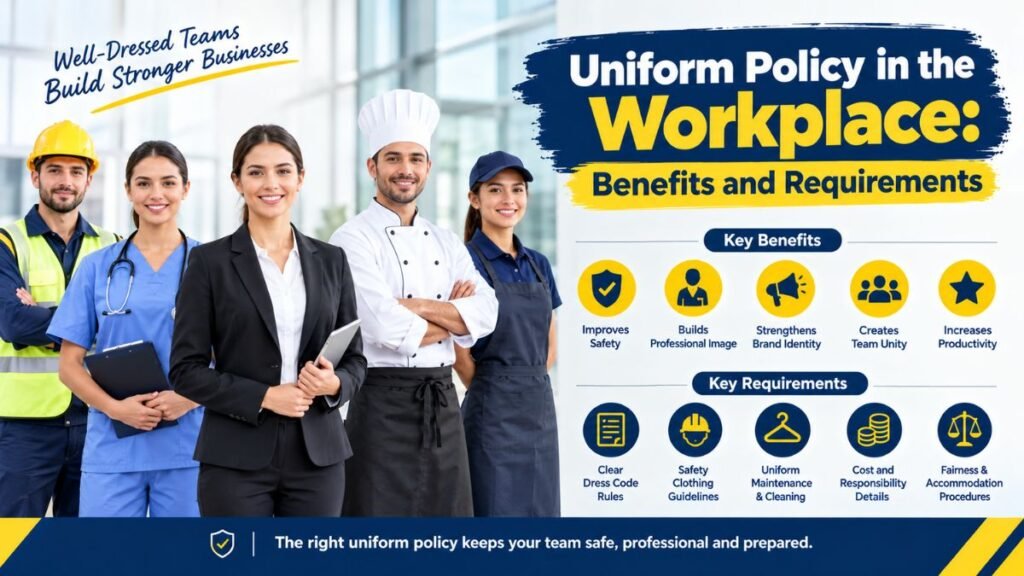
A clear uniform policy in the workplace helps businesses create a professional and organized environment. It explains what employees should wear, when uniforms are required, and how workers should maintain them. A well-planned policy can also improve safety, support brand identity, and reduce confusion about workplace clothing.
However, workplace uniform rules should do more than control appearance. They must consider employee comfort, job duties, workplace hazards, and individual needs. Employers should communicate expectations clearly and apply them fairly.
In this guide, you will learn about the benefits and requirements of a workplace uniform policy. You will also discover how to create practical rules, choose suitable uniforms, and avoid common mistakes.
What Is a Uniform Policy in the Workplace?
A uniform policy in the workplace is a written set of rules that explains employees’ clothing requirements. It may specify uniform styles, colors, approved footwear, identification badges, and grooming expectations. Some businesses require a complete uniform, while others only set basic dress code standards.
For example, a restaurant may require branded shirts, dark trousers, and closed-toe shoes. A factory may require workwear, safety footwear, and protective equipment. An office may use business-casual clothing with branded shirts for customer-facing roles.
The policy should match the company’s operations and working conditions. It should also explain which employees must follow the rules and when exceptions may apply.
Why Is a Uniform Policy in the Workplace Important?
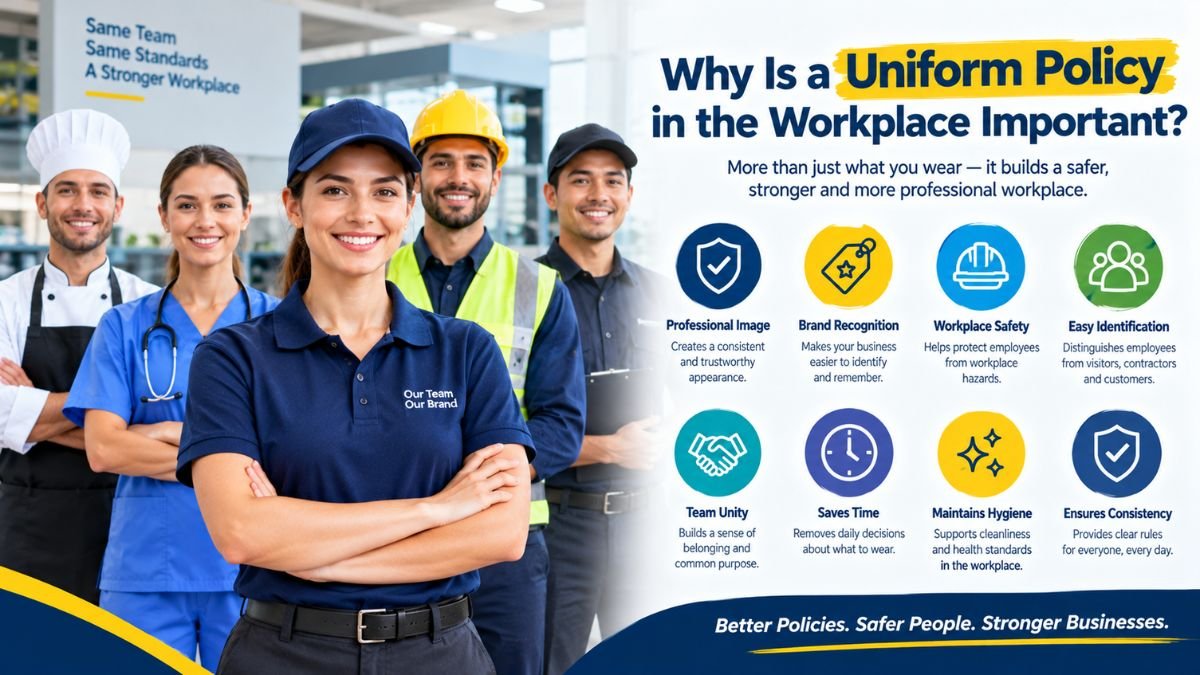
A workplace uniform policy provides employees with clear clothing expectations. Without written guidelines, workers may receive different instructions from different managers. This can lead to confusion, inconsistent decisions, and unnecessary disputes.
A consistent policy also helps businesses maintain a professional appearance. Customers can identify staff more easily, especially in busy workplaces. In some industries, uniforms also support hygiene and safety procedures.
Most importantly, a good policy balances business needs with employee well-being. Clothing should be suitable for the work employees perform. It should not create unnecessary discomfort or prevent workers from completing their duties safely.
Benefits of a Uniform Policy in the Workplace
1. Creates a Professional Business Image
Uniforms help employees present a consistent appearance. Matching clothing can make a business look organized and reliable. This is especially useful in retail stores, hotels, restaurants, healthcare facilities, and customer service environments.
A professional appearance can also help customers recognize employees quickly. Staff members become easier to identify when customers need assistance. As a result, uniforms can support a more organized customer experience.
2. Strengthens Brand Recognition
Branded uniforms can make a company’s identity more visible. Colors, logos, and consistent designs help customers connect employees with the business. This can be valuable for companies with multiple locations or teams working outside the office.
For example, delivery workers wearing branded jackets can help customers identify authorized staff. Retail employees wearing company colors can also make stores easier to navigate.
However, branding should not outweigh comfort or safety. Uniform designs must suit the workplace and the tasks employees perform.
3. Improves Workplace Safety
Safety is one of the most important reasons for requiring specific work clothing. Employees in manufacturing, construction, warehouses, and chemical facilities may face physical or environmental hazards. Suitable clothing can help reduce exposure to certain risks.
Depending on the job, workers may need high-visibility garments, protective coveralls, safety footwear, gloves, or flame-resistant clothing. These items should be selected according to the hazards present and the relevant safety requirements.
Ordinary branded uniforms are not automatically protective equipment. Employers should assess workplace risks and provide suitable personal protective equipment when required. OSHA explains the importance of appropriate PPE selection, fit, maintenance, and training. See the OSHA PPE guidance.
4. Makes Employees Easier to Identify
Uniforms help distinguish employees from visitors, contractors, and customers. This is particularly useful in hospitals, hotels, factories, airports, and large retail facilities.
Businesses can use different colors, badges, or garment styles to identify specific departments. For example, maintenance workers may wear one color while customer service staff wear another.
Clear identification can improve communication and help visitors find assistance. It may also support site security when combined with proper access controls.
5. Reduces Daily Clothing Decisions
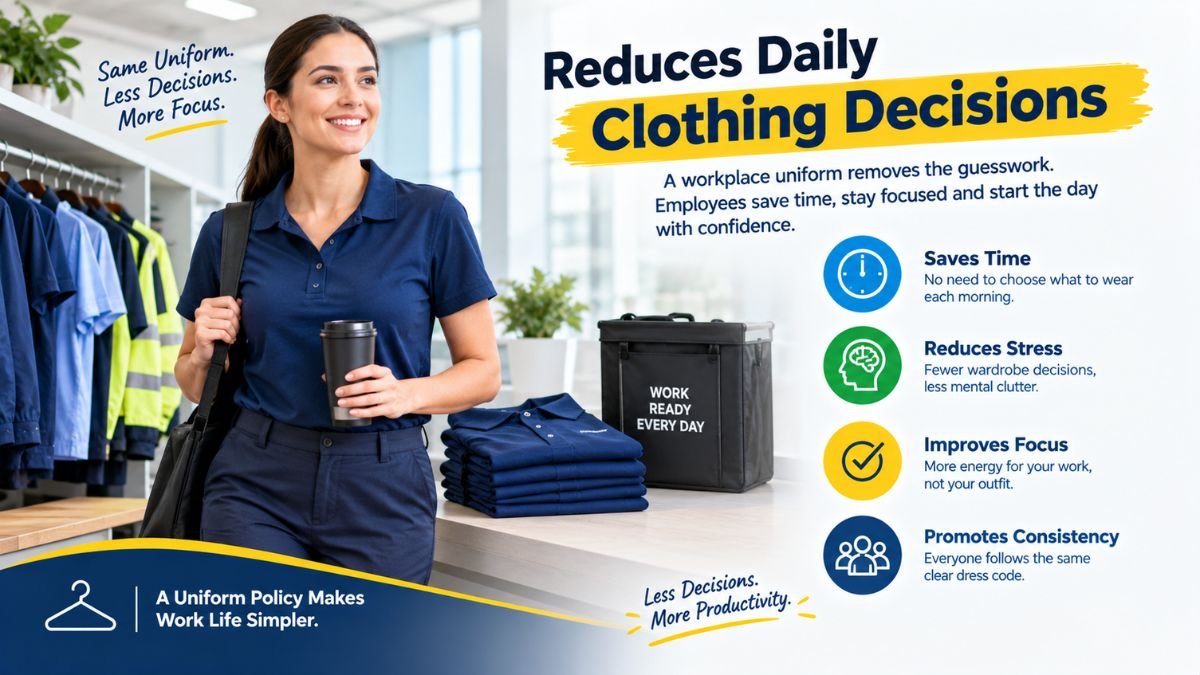
A uniform can simplify employees’ daily routines. Workers do not need to decide which professional outfit to wear each morning. They can follow the same basic clothing requirements for their shifts.
This can also reduce uncertainty about suitable workplace attire. Employees know what is expected before arriving at work. Clear rules can prevent avoidable disagreements about clothing choices.
6. Supports Team Unity
Matching uniforms can create a shared sense of belonging. Employees may feel more connected when they represent the same organization. Uniforms can also reduce visible differences in clothing styles and prices.
However, uniforms alone cannot build a strong team culture. Respectful management, fair treatment, and good communication remain essential. Clothing should support teamwork rather than become a source of pressure or exclusion.
7. Supports Hygiene and Cleanliness
Certain workplaces need clothing rules to support hygiene. Food production, healthcare, laboratories, and clean manufacturing facilities may require specific garments. These rules can help control contamination when combined with proper cleaning and handling procedures.
Employers should explain how often uniforms must be changed and how they should be cleaned. They should also clarify whether employees or the company handle laundry.
Where contamination is possible, ordinary washing may not be sufficient. Businesses should follow the hygiene procedures and industry standards that apply to their operations.
8. Helps Maintain Consistent Standards
A written uniform policy gives managers a shared reference point. Employees receive the same core instructions instead of relying on informal expectations. This makes training and supervision easier.
Consistency also helps managers address problems fairly. They can refer to the written policy when discussing missing uniforms or unsuitable footwear. Rules should be applied consistently while allowing appropriate exceptions.
Key Requirements of a Uniform Policy in the Workplace
1. Define Which Employees Must Wear Uniforms
The policy should identify the roles covered by the uniform requirement. Some businesses may require uniforms for all employees. Others may apply different rules to office staff, warehouse workers, technicians, and customer-facing teams.
Explain whether uniforms are required during every shift, only during customer interactions, or at specific work locations. Include any requirements for temporary workers, contractors, and visitors where appropriate.
Clear coverage prevents employees from guessing whether a rule applies to them. It also helps supervisors enforce the policy consistently.
2. Specify Approved Uniform Items
List each garment or accessory employees must wear. This may include shirts, trousers, jackets, aprons, dresses, shoes, and identification badges.
Describe approved colors, designs, logos, and acceptable alternatives. If different departments have different uniforms, explain those differences separately.
For example, a warehouse employee may need durable trousers and safety footwear. A receptionist may need a branded shirt and professional trousers. Each requirement should match the role.
3. Set Practical Fit and Comfort Standards
Uniforms should allow employees to perform their duties without unnecessary restriction. Poorly fitted clothing can affect movement, comfort, and concentration. Employers should consider garment sizing, fabric weight, ventilation, and the physical demands of each job.
Employees may work in hot kitchens, cold storage areas, outdoor locations, or warm factories. Uniform materials should suit those conditions. Where possible, offer suitable sizes and options for different body shapes.
Comfort should not replace necessary protection. Instead, employers should select garments that provide the required protection while supporting practical movement.
4. Explain Workplace Safety Clothing Requirements
Some roles require more than a standard uniform. Employees may need protective clothing to reduce exposure to heat, chemicals, sharp objects, dust, or other hazards.
The policy should explain which protective items are required for each task. It should also cover proper use, inspection, storage, cleaning, and replacement.
Where applicable, employers should provide training on protective equipment. Workers need to understand its purpose, limitations, and correct use. Follow the safety standards that apply to the workplace and location.
5. Establish Uniform Maintenance Rules
Employees should know how to keep uniforms clean and presentable. The policy can explain washing instructions, stain removal, repairs, and replacement procedures.
Some uniforms can be washed at home. Others may require industrial laundering because of workplace contamination or specialized materials. Employers should provide clear instructions for each situation.
The policy should also explain what employees should do when a uniform becomes damaged. Torn clothing, broken fasteners, or worn protective materials may need immediate replacement.
6. Explain Uniform Costs and Responsibilities
A workplace uniform policy should clearly explain who supplies, pays for, cleans, and replaces uniforms. Responsibilities can depend on local employment laws, industry requirements, and the type of garment.
For example, a company may provide branded shirts while employees maintain ordinary work trousers. A business may also operate a uniform laundry service or provide replacement garments.
Required protective equipment can have specific employer-payment obligations. In the United States, OSHA generally requires employers to pay for PPE used to comply with its standards, subject to limited exceptions. Review the OSHA PPE payment rules and applicable local laws.
7. Include Fairness and Accommodation Procedures
Uniform requirements should be applied fairly and consistently. Employers should avoid rules that discriminate against employees based on protected characteristics.
Some employees may need adjustments because of religious practices, disability, medical needs, or other legally protected circumstances. Employers should provide a clear process for requesting an exception or alternative garment.
In the United States, the EEOC explains that dress codes may require reasonable accommodation for religious practices and disabilities, subject to applicable legal standards. Read the EEOC guidance on workplace dress codes.
Employers should assess requests individually. They should consider practical alternatives that preserve legitimate safety and operational requirements.
8. Describe Consequences for Repeated Noncompliance
Employees should understand what happens when they repeatedly ignore uniform requirements. The policy may describe reminders, coaching, written warnings, or other steps under the company’s disciplinary process.
Consequences should be proportionate and consistent with employment contracts and applicable law. Managers should also investigate why a problem occurred before taking action.
An employee may have a damaged uniform, an unavailable size, or an approved accommodation request. Addressing the cause can be more effective than immediate punishment.
How to Create a Uniform Policy in the Workplace
Step 1: Identify Business Needs
Start by deciding why uniforms are necessary. A company may need them for branding, hygiene, employee identification, safety, or customer service.
Different goals require different clothing choices. A restaurant needs different garments from a construction company. Identify the main purpose before selecting uniform styles.
Step 2: Assess Job Duties and Workplace Hazards
Review the tasks employees perform and the conditions they face. Consider heat, chemicals, machinery, slippery floors, outdoor weather, and contamination risks.
Where hazards exist, conduct the appropriate workplace assessment. Choose protective clothing and equipment based on the actual risks, rather than appearance alone.
Step 3: Consult Employees and Supervisors
Ask employees about comfort, sizing, movement, and maintenance concerns. Supervisors can identify practical problems that may not be obvious during planning.
Consultation can also reveal differences between departments. For example, warehouse staff may need more durable fabrics than office workers. Employee feedback can help prevent expensive uniform mistakes.
Step 4: Choose Suitable Materials and Designs
Select garments that suit the work environment. Cotton blends may work well for some everyday uniforms, while specialized fabrics may be needed for heat, chemical exposure, or high-visibility tasks.
Consider durability, breathability, washability, fit, and replacement costs. Confirm that protective garments meet the relevant requirements for their intended use.
Do not assume that a fabric is safe for every hazard. Chemical resistance, flame resistance, and high visibility are different properties. Verify product specifications before purchasing.
Step 5: Write Clear and Simple Rules
Use plain language to explain what employees must wear. Avoid vague instructions such as “dress appropriately” without defining the expected standard.
Include examples of acceptable and unacceptable clothing where helpful. State when uniforms must be worn and whom employees should contact with questions.
The final policy should be easy to understand. Employees should not need to interpret complicated wording to follow basic requirements.
Step 6: Review Legal and Safety Obligations
Check the employment laws and workplace safety rules that apply to your location. Requirements can differ by country, state, industry, and type of work.
Consider equal treatment, accommodation requests, wage deductions, uniform costs, hygiene rules, and PPE obligations. Seek qualified legal or safety advice when requirements are unclear.
A policy should support compliance rather than create new legal risks. Review it whenever relevant laws, equipment, or job duties change.
Step 7: Communicate the Policy
Share the policy before it takes effect. Explain the reason for the rules and give employees enough time to obtain the required clothing.
Provide copies through employee handbooks, onboarding materials, staff meetings, or internal systems. Ask employees to confirm that they understand the requirements.
Managers should receive the same instructions. Consistent communication helps prevent conflicting decisions between departments.
Step 8: Review and Update the Policy
Review the policy regularly and after major workplace changes. New machinery, chemicals, job duties, or safety guidance may require different clothing.
Collect feedback about comfort, quality, sizing, and replacement needs. Use this information to improve the policy and purchasing process.
A useful policy should remain practical as the business grows. Regular reviews help keep the rules relevant and effective.
Examples of Workplace Uniform Policies
Office Uniform Policy
An office may require business-casual clothing or branded shirts. Employees may need to keep garments clean and wear identification badges in designated areas.
The policy should explain acceptable trousers, skirts, footwear, and outerwear. It should also address client meetings and special events.
Factory Uniform Policy
A factory may require durable workwear suited to machinery and production tasks. Depending on the hazards, employees may also need safety shoes, eye protection, gloves, or other PPE.
The policy should identify prohibited items when they create hazards. Loose clothing, jewelry, or unsecured hair may present risks around certain machinery. Requirements should reflect a proper hazard assessment.
Restaurant Uniform Policy
Restaurant employees may need branded shirts, aprons, hair restraints, and suitable footwear. Food-handling roles may have additional hygiene requirements.
The policy should explain laundry, garment changes, and procedures for damaged or contaminated uniforms. It should also distinguish appearance rules from food safety requirements.
Healthcare Uniform Policy
Healthcare settings may require scrubs, identification badges, protective gowns, or other specialized items. Requirements depend on the role, care setting, and infection-control procedures.
The policy should explain when garments must be changed and how they should be handled. It should follow the facility’s hygiene and safety protocols.
Construction Uniform Policy
Construction workers may need hard hats, safety footwear, and high-visibility garments. Other protective items depend on the worksite and specific hazards.
The policy should identify mandatory equipment and explain inspection and replacement procedures. Ordinary workwear should not be treated as a substitute for required protective equipment.
Common Mistakes to Avoid in a Workplace Uniform Policy
Using Vague Language
Unclear rules can cause inconsistent enforcement. Employees may not know what counts as acceptable clothing or when a uniform is required.
Use specific garment names, examples, and instructions. Clear wording makes the policy easier to follow.
Ignoring Employee Comfort
Uncomfortable uniforms can reduce satisfaction and make tasks harder. Poor fabric choices may be especially problematic in hot, cold, or physically demanding environments.
Test garments before placing large orders. Consider fit, movement, breathability, and the needs of different roles.
Treating Every Job the Same
A single uniform may not suit every department. Office employees, cleaners, technicians, and production workers face different demands.
Set shared standards where useful, but allow role-specific clothing when necessary. Safety and practicality should guide those decisions.
Overlooking Legal Accommodation
A rigid policy may create problems when employees need religious or disability-related adjustments. Employers should provide a clear process for requesting accommodation and review requests individually.
Failing to Explain Costs
Employees may be confused about who pays for uniforms or cleaning. Explain these responsibilities before the policy starts.
Check local law before requiring workers to purchase items or accept deductions from their wages.
Neglecting Damaged Clothing
Worn or damaged clothing may look unprofessional or fail to provide intended protection. Set a clear procedure for reporting and replacing unsuitable garments.
How to Enforce a Uniform Policy Fairly
Managers should explain the rules before enforcing them. Employees need access to the policy, suitable uniforms, and a way to ask questions.
Apply the same core standards to employees in comparable roles. Document repeated issues and discuss them privately. Avoid public criticism that could embarrass or discourage workers.
Before taking disciplinary action, check whether the employee lacks a suitable garment or needs an accommodation. Resolve practical problems first where possible.
Managers should also receive training on the policy. This helps ensure consistent decisions across teams and locations.
How Often Should a Uniform Policy Be Reviewed?
Review the policy at least annually as a practical management measure. A business may need more frequent reviews when its operations change quickly.
Review it sooner after a workplace incident, new hazard assessment, uniform redesign, or change in applicable law. Employee feedback can also reveal issues that need attention.
Keep a record of important changes and communicate updates to affected staff. This helps employees understand their current responsibilities.
Conclusion
A uniform policy in the workplace helps businesses set clear clothing expectations and maintain consistent standards. It can strengthen brand identity, improve employee identification, and support workplace safety.
The best policy is practical, fair, and easy to understand. It should explain uniform requirements, maintenance, costs, safety clothing, and accommodation procedures. Employers should also review the policy regularly and follow applicable laws.
By involving employees and choosing suitable garments, businesses can create a uniform policy that supports both operational needs and worker well-being.
Frequently Asked Questions
1. What Is a Uniform Policy in the Workplace?
A uniform policy is a written document that explains what employees must wear at work. It may cover clothing styles, colors, footwear, identification badges, cleaning, and protective equipment.
2. Why Is a Workplace Uniform Policy Important?
It creates consistent clothing expectations and can improve professional appearance, employee identification, brand recognition, and safety. Clear rules can also reduce confusion and disagreements.
3. What Should a Uniform Policy Include?
It should explain who must wear uniforms, approved garments, safety requirements, fit, cleaning, replacement, costs, accommodation procedures, and consequences for repeated noncompliance.
4. Can an Employer Require Employees to Wear Uniforms?
In many situations, employers can establish workplace dress codes and uniform requirements. However, those rules must comply with applicable employment, discrimination, accommodation, and safety laws.
5. Who Pays for Workplace Uniforms?
Payment responsibilities depend on local law, company policy, employment arrangements, and whether the clothing is required protective equipment. Employers should explain the rules before implementation.
6. Are Workplace Uniforms the Same as PPE?
No. A standard uniform mainly supports appearance, identification, or ordinary work needs. Personal protective equipment is selected to reduce exposure to specific hazards and must meet relevant requirements.
7. Can Employees Request an Alternative Uniform?
Yes, employees can raise concerns and request alternatives. Depending on applicable law and the circumstances, employers may need to consider accommodations for religious practices, disability, or other protected needs.
8. How Can Employers Make Uniform Policies Fair?
Employers should use clear rules, apply them consistently, consider accommodation requests, provide suitable garments, and train managers. They should also review concerns before taking disciplinary action.
9. What Happens If an Employee Does Not Follow the Uniform Policy?
The employer may use reminders, coaching, or disciplinary procedures, depending on the situation and applicable rules. Managers should first check whether the employee faces a practical barrier or has an accommodation need.
10. How Often Should a Uniform Policy Be Updated?
An annual review is a useful starting point. Employers should also review the policy after changes in job duties, workplace hazards, uniform design, or applicable legal requirements.