
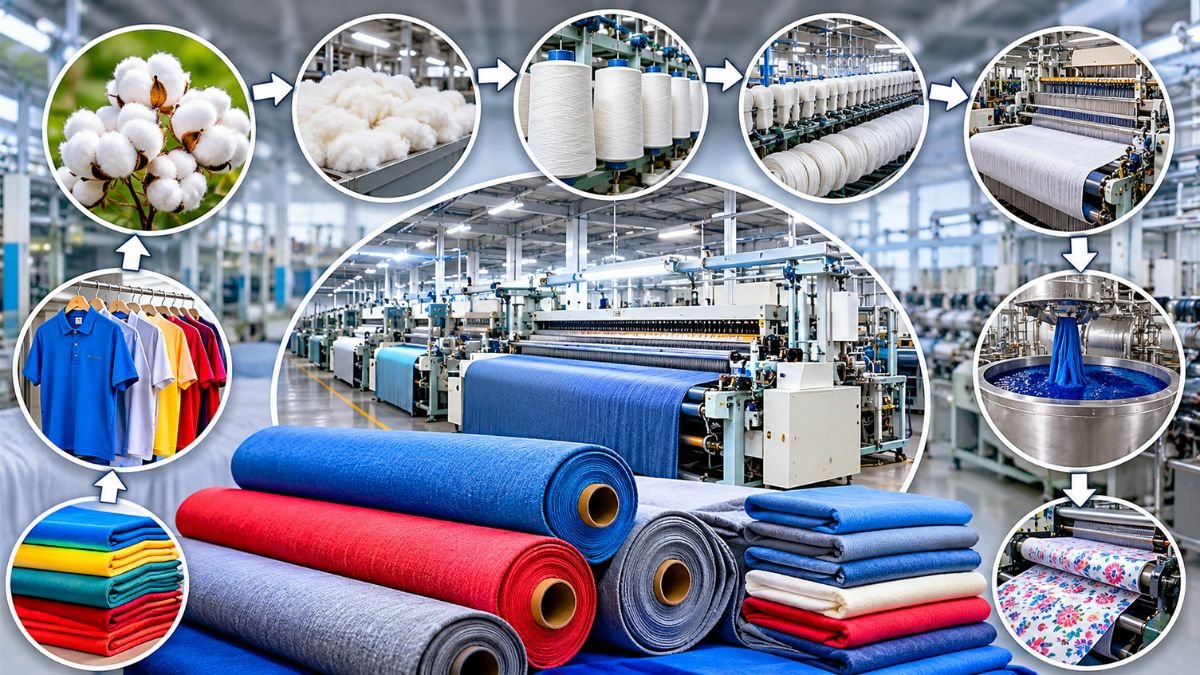
Cloth is an essential material used in everyday products. It is found in clothing, uniforms, bedding, curtains, furniture, and industrial textiles. However, few people understand how raw materials become finished cloth.
The manufacturing process involves several important stages. It starts with selecting suitable raw fibers. Manufacturers then prepare these fibers and convert them into yarn. The yarn is used to create fabric through weaving or knitting.
After fabric formation, manufacturers apply dyeing, printing, and finishing treatments. These processes improve the fabric’s appearance, texture, strength, and performance.
Modern textile factories use advanced machines to produce cloth efficiently. However, the basic manufacturing principles remain similar across many textile products.
Understanding how cloth is manufactured helps clothing brands, designers, textile buyers, and consumers make informed decisions. It also explains why different fabrics have different qualities and applications.
In this guide, we will explain the complete cloth manufacturing process. You will learn about raw materials, fiber preparation, spinning, weaving, knitting, dyeing, finishing, and quality inspection.
Sourcing fabric for production? Meet the Negora Fist workwear manufacturer, see the ripstop pants, and read the best fabric for workwear.
What Is Cloth Manufacturing?
Cloth manufacturing is the process of converting textile fibers into usable fabric. It involves different mechanical and chemical operations that prepare raw materials for textile production.
Manufacturers use natural, synthetic, and regenerated fibers to produce different types of cloth.
The manufacturing process depends on the material and its intended application. For example, cotton fabric requires different processing methods from polyester or wool.
Most traditional cloth manufacturing processes include these stages:
- Selecting suitable raw materials.
- Cleaning and preparing fibers.
- Blending different fibers when required.
- Converting fibers into yarn.
- Preparing yarn for fabric production.
- Creating fabric through weaving or knitting.
- Pretreating unfinished fabric.
- Applying dyeing and printing treatments.
- Finishing the fabric.
- Inspecting and packaging the finished material.
Not every fabric follows the same production sequence. Nonwoven fabrics, for example, can be produced directly from fibers without traditional spinning, weaving, or knitting.
What Materials Are Used to Manufacture Cloth?
Raw materials play an important role in cloth manufacturing. They determine the final fabric’s softness, strength, durability, appearance, and comfort.
Manufacturers generally use three major categories of textile fibers.
1. Natural Fibers
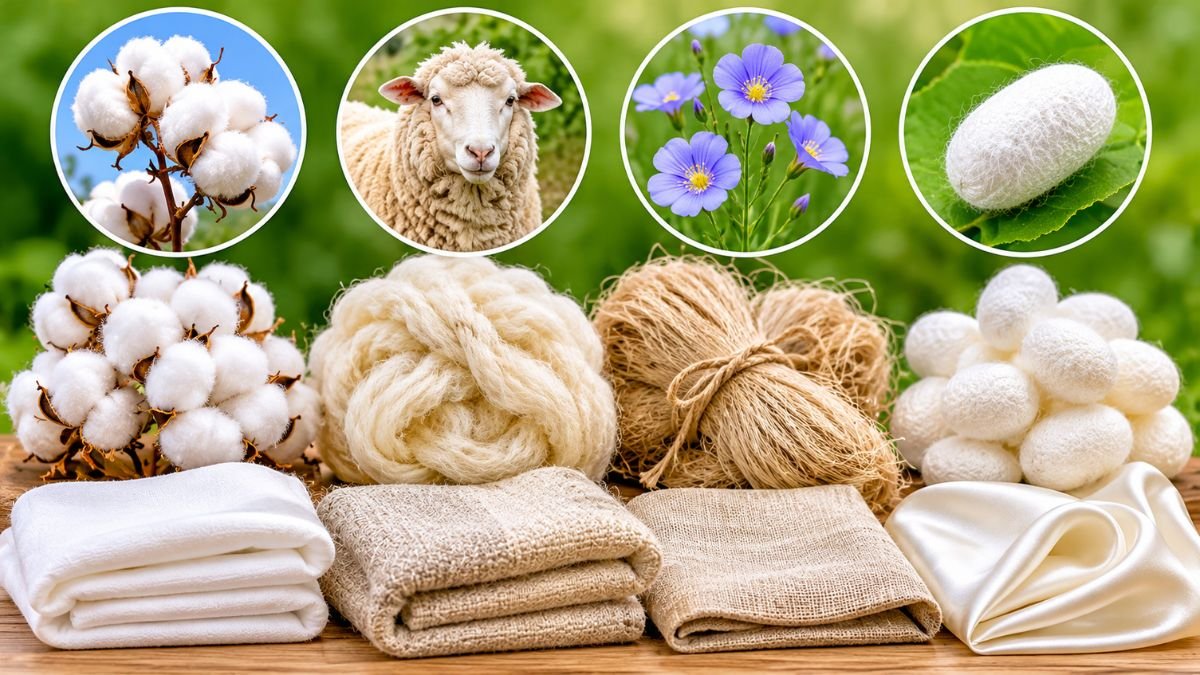
Natural fibers come from plants or animals. They are commonly used in clothing, household textiles, and other fabric products.
Cotton: Cotton is a popular natural fiber. It feels soft, absorbs moisture, and allows airflow. Manufacturers use it for T-shirts, shirts, jeans, towels, and bedding.
Wool: Wool mainly comes from sheep. It provides warmth and insulation. It is commonly used for sweaters, coats, blankets, and winter clothing.
Silk: Silk is a natural protein fiber produced by silkworms. It has a smooth surface and attractive appearance. Manufacturers use it for luxury garments, scarves, dresses, and decorative textiles.
Linen: Linen comes from the flax plant. It is known for its strength, breathability, and natural texture. It is suitable for summer clothing, trousers, shirts, and household fabrics.
2. Synthetic Fibers
Synthetic fibers are produced through industrial chemical processes. Manufacturers create these fibers from polymers and convert them into continuous filaments or staple fibers.
Common synthetic materials include:
- Polyester: A durable, wrinkle-resistant material used in sportswear, uniforms, and everyday clothing.
- Nylon: A strong and lightweight fiber used in jackets, bags, activewear, and outdoor products.
- Acrylic: A lightweight fiber often used as an alternative to wool.
- Polypropylene: A lightweight fiber used in thermal clothing and technical textiles.
- Elastane: A highly stretchable fiber blended with cotton, polyester, or nylon.
Synthetic fibers offer different performance benefits. Their properties depend on their chemical composition and manufacturing methods.
3. Regenerated Fibers
Regenerated fibers are manufactured by processing natural raw materials into textile fibers.
Many regenerated fibers come from cellulose-based materials, such as wood pulp.
Common examples include:
- Viscose rayon.
- Modal.
- Lyocell.
- Cupro.
These fibers can provide softness, smoothness, and moisture absorption. Their properties depend on the raw material and production process.
How Is Cloth Manufactured? Step-by-Step Process
Cloth manufacturing involves several connected stages. Each stage prepares the material for the next operation.
Let’s explore how raw fibers become finished textile materials.
Once the fabric is made, it becomes a garment. See how garments are made and the best fabric for workwear.
1. Selecting Raw Materials for Cloth Manufacturing
The first stage involves selecting suitable raw materials. Manufacturers consider the fabric’s purpose before choosing the fibers.
For example, a clothing brand producing summer T-shirts may choose cotton or cotton-polyester blends. A company producing winter jackets may prefer wool, polyester, or nylon.
Material selection depends on several factors.
Fabric Purpose: Manufacturers identify how customers will use the finished material. Clothing, furniture, workwear, and industrial products have different requirements.
Strength and Durability: Some applications require fabrics that resist tearing, abrasion, and repeated washing.
Comfort: Garments worn directly against the skin often need soft and breathable materials.
Cost: Raw material prices influence the final manufacturing budget. Brands must balance material quality with production expenses.
Appearance: Fiber selection affects texture, drape, surface appearance, and color performance.
After selecting suitable materials, manufacturers send them for further processing.
2. Cleaning and Preparing the Fibers
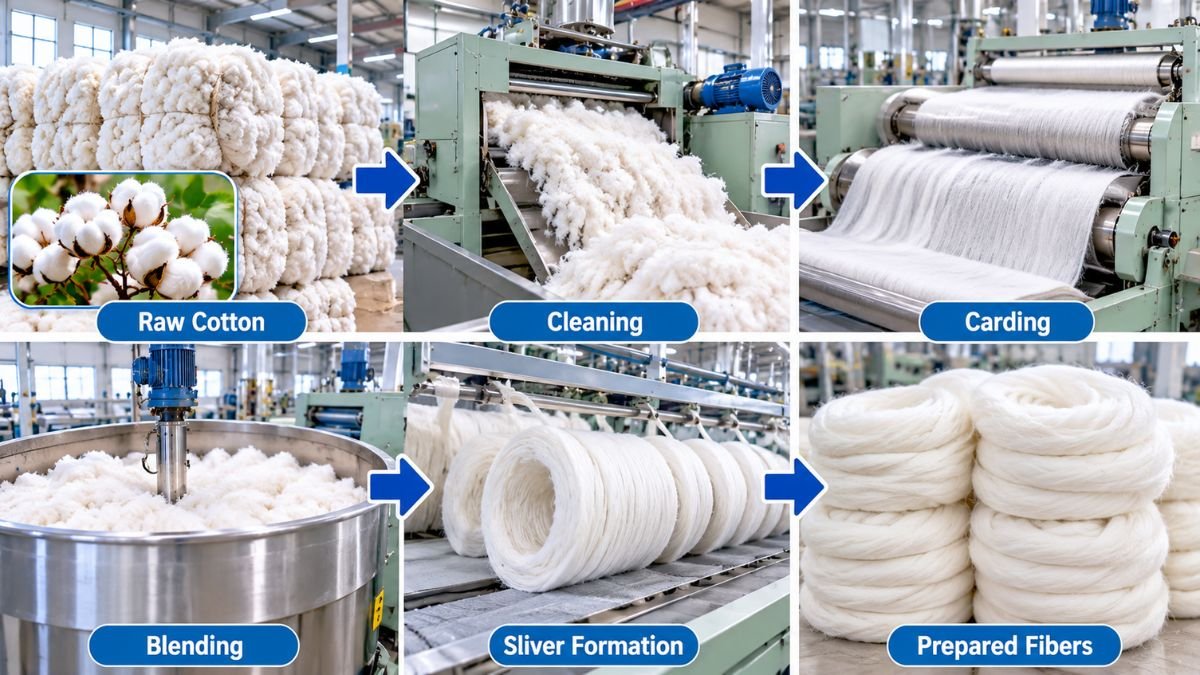
Raw fibers usually contain impurities that must be removed before further processing. These impurities may include dust, seeds, plant matter, natural oils, and other unwanted substances.
Cleaning requirements depend on the fiber type.
For cotton, manufacturers first separate cotton lint from its seeds. This process is called ginning. The cleaned cotton then moves through additional opening and cleaning operations.
Wool requires washing to remove dirt, grease, and natural impurities. Other natural fibers may need different preparation methods.
Synthetic fibers follow a different process. Their production begins with polymer processing and fiber formation.
The main objectives of fiber preparation include:
- Removing unwanted impurities.
- Separating compressed fiber bundles.
- Improving fiber cleanliness.
- Preparing fibers for uniform processing.
- Reducing contamination during production.
Proper preparation improves yarn quality and reduces manufacturing problems.
3. Blending Different Fibers
Some fabrics contain only one fiber type. Others combine two or more materials to achieve specific properties.
Blending is the process of mixing different fibers before spinning. Manufacturers use this technique to combine the advantages of different materials.
For example, cotton and polyester are frequently blended together.
Cotton provides softness and moisture absorption. Polyester improves durability and wrinkle resistance. Their combination creates practical fabric for everyday clothing.
Other common blends include:
- Cotton and elastane for stretch clothing.
- Polyester and viscose for comfortable garments.
- Wool and nylon for improved durability.
- Cotton and linen for different texture and comfort properties.
The blending ratio affects the final fabric characteristics.
A 65% polyester and 35% cotton fabric behaves differently from a 50% cotton and 50% polyester blend.
Manufacturers select suitable ratios according to product requirements.
4. Converting Fibers Into Yarn Through Spinning
Spinning is one of the most important stages in traditional cloth manufacturing. It converts loose staple fibers into continuous yarn.
Yarn provides the structure needed for weaving and knitting.
Opening and Mixing
Prepared fibers enter opening machines. These machines separate compressed fiber bundles into smaller groups.
Manufacturers may also mix fibers to achieve consistent material composition.
Carding
Carding separates, cleans, and arranges fibers.
Special machines use wire-covered rollers to remove remaining impurities. They also help align fibers in a more organized direction.
The machine produces a soft, rope-like strand called a sliver.
Combing
Combing is an additional operation used when manufacturers need finer and more uniform yarn.
It removes shorter fibers and additional impurities. It also improves fiber alignment.
Combed yarn is commonly used for premium shirts, T-shirts, and other quality garments.
However, not every yarn requires combing.
Drawing
During drawing, several slivers pass through rollers. These rollers stretch and combine the strands.
This operation improves thickness consistency and fiber alignment.
Roving
The drawn sliver becomes thinner through another preparation stage. This stage adds a small amount of twist to create roving.
Roving is easier to handle during final spinning.
Final Spinning
The spinning machine draws out the roving and adds twist. This creates stronger, continuous yarn.
Different spinning systems produce different yarn characteristics.
Common methods include ring spinning, rotor spinning, and air-jet spinning.
Winding
Finally, workers transfer the yarn onto cones or other packages.
Workers prepare these packages for fabric manufacturing.
5. Preparing Yarn for Fabric Production
After spinning, yarn needs preparation before entering weaving or knitting machines.
This stage helps maintain consistent yarn tension and reduces production interruptions.
The preparation method depends on the fabric construction.
Yarn Winding
Winding transfers yarn from smaller packages onto larger cones or suitable machine packages.
It can also remove certain yarn defects through electronic yarn-clearing systems.
Warping
Warping is an important preparation step for woven fabrics.
It involves arranging many yarns parallel to one another. This step winds these yarns onto a large beam.
The number of yarns and their arrangement depend on the fabric design.
Sizing
Sizing applies a protective coating to warp yarns before weaving.
The coating helps reduce friction and yarn breakage during high-speed loom operations.
It is particularly useful for certain cotton and blended yarns.
Yarn Preparation for Knitting
Knitting requires yarn packages that can feed smoothly into knitting machines.
Manufacturers may apply suitable winding, waxing, or other preparation treatments.
Proper yarn preparation improves production efficiency and fabric consistency.
6. Forming Fabric Through Weaving
Weaving is one of the oldest and most widely used fabric manufacturing methods.
It creates cloth by interlacing two sets of yarns at approximately right angles.
People call the two main yarn systems warp and weft.
Warp Yarns: These run lengthwise through the fabric. They remain under controlled tension during weaving.
Weft Yarns: These run across the fabric. The weaving machine inserts them between the warp yarns.
A machine called a loom performs this operation.
Modern textile factories use different types of looms to produce fabrics at commercial speeds.
How Does the Weaving Process Work?
The weaving process follows several basic operations.
Shedding: The loom separates warp yarns into different groups. This creates an opening called a shed.
Picking: The machine inserts a weft yarn through the shed.
Beat-Up: A reed pushes the inserted weft yarn against the previously formed fabric.
Take-Up: The completed fabric moves forward and winds onto a cloth roller.
These operations repeat continuously until the machine produces the required fabric length.
Common Types of Woven Fabrics
Plain Weave: This is a simple structure in which warp and weft yarns pass over and under each other alternately. It is common in shirts, basic cotton fabrics, and lightweight textiles.
Twill Weave: This structure creates diagonal lines on the fabric surface. Denim and many workwear fabrics use twill construction.
Satin Weave: Satin uses longer yarn floats to create a smooth and lustrous surface. Manufacturers commonly use it for dresses, linings, and decorative textiles.
Weaving allows manufacturers to create fabrics with different weights, textures, and durability levels.
7. Forming Fabric Through Knitting
Knitting is another major method of cloth manufacturing.
Unlike weaving, knitting creates fabric by connecting loops of yarn. Special needles form and connect these loops to produce a flexible structure.
Knitted fabrics are generally stretchier than comparable woven fabrics. Their flexibility makes them suitable for comfortable everyday clothing.
How Does the Knitting Process Work?
The knitting machine feeds yarn through a series of needles.
Each needle forms a new loop. The new loop passes through an existing loop to create a connected fabric structure.
This operation continues until the machine produces the required fabric length.
Modern knitting machines can produce different patterns, textures, and fabric weights.
Common Types of Knitted Fabrics
Single Jersey: This is a popular knitted structure used in T-shirts, casual clothing, and lightweight garments.
Rib Knit: Rib fabrics contain alternating raised and recessed lines. They are often used for cuffs, collars, and stretch garments.
Interlock Knit: Interlock creates a thicker and more stable structure than basic single jersey. It is suitable for comfortable clothing and premium T-shirts.
Knitted fabrics are commonly used in sportswear, underwear, sweaters, leggings, and casual garments.
Difference Between Weaving and Knitting
| Feature | Weaving | Knitting |
|---|---|---|
| Construction | Interlaced yarns | Connected yarn loops |
| Stretch | Usually lower | Usually higher |
| Structure | Generally stable | Generally flexible |
| Common products | Shirts, denim, uniforms | T-shirts, sweaters, leggings |
| Main machine | Loom | Knitting machine |
Both methods are important in modern textile manufacturing. The right choice depends on the desired fabric properties.
8. Understanding Nonwoven Cloth Manufacturing
Not all cloth is manufactured through weaving or knitting.
Nonwoven manufacturing creates fabric directly from fibers or filaments. It does not require traditional yarn production.
Manufacturers arrange fibers into a web and bond them together using different techniques.
Common bonding methods include:
Mechanical Bonding: Needles or water jets connect fibers to create a stable structure.
Thermal Bonding: Heat softens suitable fibers or bonding components. Pressure and cooling help create a connected material.
Chemical Bonding: Adhesives or binding agents hold fibers together.
Nonwoven fabrics are widely used in medical products, hygiene materials, filters, protective products, and disposable items.
This manufacturing method can be faster for specific products. It also allows manufacturers to produce materials with specialized properties.
9. Pretreating the Fabric Before Dyeing
After weaving or knitting, traditional fabrics are often called greige or grey fabrics.
These fabrics may contain natural impurities, machine oils, sizing materials, and other unwanted substances.
They need pretreatment before dyeing or printing.
Pretreatment prepares the material for uniform coloring and finishing.
Singeing
Singeing removes loose fibers and surface fuzz.
The fabric passes over controlled flames or heated surfaces. This helps create a cleaner and smoother surface.
Desizing
Desizing removes sizing materials applied to warp yarns during weaving.
These materials can interfere with later dyeing and finishing operations.
Scouring
Scouring removes natural oils, waxes, dirt, and other impurities.
It improves the fabric’s ability to absorb water and chemical treatments.
Bleaching
Bleaching removes unwanted natural coloration.
It creates a lighter and more uniform base for dyeing or printing.
Hydrogen peroxide is commonly used for cotton bleaching under controlled industrial conditions.
Mercerizing
Manufacturers mainly use mercerizing as a treatment for cotton.
Workers treat the fabric with a controlled caustic soda solution.This changes the fiber structure and can improve luster, strength, and dye absorption.
Not every fabric requires every pretreatment operation. Manufacturers select treatments according to fiber composition and final product requirements.
10. Dyeing the Fabric
Dyeing gives cloth its desired color.
Manufacturers use different dyes and processing methods according to the fiber type and color requirements.
For example, cotton, polyester, nylon, and wool generally require different dyeing systems.
Common Fabric Dyeing Methods
Piece Dyeing: Manufacturers dye completed fabric after weaving or knitting. This is one of the most common methods for commercial textile production.
Yarn Dyeing: Manufacturers color yarn before creating the fabric. This method is useful for stripes, checks, and other patterned materials.
Fiber Dyeing: Fibers receive color before spinning. This allows manufacturers to produce specific shades throughout the yarn structure.
Garment Dyeing: Finished garments are dyed after cutting and stitching. This technique can create distinctive colors and visual effects.
How Does the Dyeing Process Work?
The fabric enters a dyeing machine with a suitable dye solution.
The machine controls temperature, processing time, chemical concentration, and other conditions.
The dye interacts with the fibers and develops the required color.
After dyeing, the fabric may require washing and additional treatments to remove excess dye and improve colorfastness.
Proper dyeing helps prevent uneven shades and unwanted color changes.
11. Printing Patterns and Designs on Cloth
Printing applies patterns, artwork, logos, and decorative designs to fabric surfaces.
Unlike solid-color dyeing, printing usually places color in specific areas of the material.
Manufacturers use different printing technologies depending on the design and production volume.
Screen Printing
Screen printing uses a prepared screen to transfer color onto the fabric.
Different screens can be used for different colors in a design.
It is commonly used for T-shirts, uniforms, and promotional textiles.
Digital Textile Printing
Digital printing transfers designs directly onto fabric through specialized printing equipment.
It allows manufacturers to create detailed patterns and multiple colors.
It is particularly useful for customized designs and smaller production runs.
Rotary Screen Printing
Rotary printing uses cylindrical screens to apply designs continuously.
It is suitable for large-scale fabric production.
Heat Transfer Printing
Heat transfer printing uses heat and pressure to transfer designs from a prepared medium onto fabric.
It is commonly used for logos, graphics, and customized garments.
Printing methods depend on fabric composition, design complexity, production volume, and durability requirements.
12. Applying Different Fabric Finishing Treatments
Finishing is an important stage in cloth manufacturing.
It improves the fabric’s appearance, feel, stability, and functional performance.
After dyeing or printing, manufacturers apply suitable finishing treatments according to the intended application.
Mechanical Finishing
Mechanical finishing uses physical processes to change the fabric surface or structure.
Common examples include:
Brushing: Raises surface fibers to create a softer or warmer texture.
Calendaring: Uses heated rollers and pressure to improve smoothness and surface appearance.
Sueding: Creates a soft, slightly textured surface through controlled abrasion.
Compacting: Helps control fabric dimensions and reduce future shrinkage.
Raising: Lifts fibers from the fabric surface to create a fuzzy or insulating texture.
Chemical Finishing
Chemical finishing applies selected substances to improve fabric performance.
Common treatments include:
Water-Repellent Finishing: Helps water remain on the fabric surface rather than spreading quickly.
Antimicrobial Finishing: Provides specific protection against microbial growth when properly tested and applied.
Flame-Resistant Finishing: Helps suitable fabrics meet defined flame-resistance requirements.
Softening: Improves the fabric’s hand feel and flexibility.
Wrinkle-Resistant Finishing: Helps reduce creasing and improve garment appearance.
Manufacturers must choose finishing treatments according to the product’s intended use and applicable safety requirements.
Some fabrics need only basic finishing. Others require specialized treatments for industrial, medical, outdoor, or protective applications.
13. Controlling Fabric Shrinkage and Dimensional Stability
Fabric shrinkage can create problems during garment manufacturing and customer use.
A garment may become smaller after washing if its fabric has not received suitable dimensional control.
Manufacturers use different processes to improve dimensional stability.
One common technique is compacting or mechanical preshrinking.
During this process, the fabric passes through controlled equipment that adjusts its dimensions.
Heat-setting is another important process for suitable synthetic fabrics.
It uses controlled heat to stabilize the material and reduce unwanted dimensional changes.
Manufacturers may also test fabric shrinkage before approving production.
Proper shrinkage control helps clothing brands maintain consistent garment measurements.
14. Inspecting and Testing the Finished Cloth
Quality inspection ensures that finished fabric meets the required specifications.
Manufacturers examine fabric rolls for visible defects and perform laboratory tests to check performance.
The inspection process helps identify problems before the material reaches clothing manufacturers or customers.
Common Fabric Quality Tests
Fabric Weight Test: Measures the weight of fabric per square meter, commonly expressed as GSM.
Tensile Strength Test: Measures the force required to break a fabric sample.
Tear Strength Test: Evaluates how well the fabric resists tearing.
Colorfastness Test: Checks how well the fabric retains its color during washing, rubbing, or exposure to light.
Shrinkage Test: Measures dimensional changes after washing or other specified treatments.
Pilling Test: Evaluates the formation of small fiber balls on the fabric surface.
Dimensional Stability Test: Checks whether the fabric maintains its measurements under specified conditions.
Visual Fabric Inspection
Quality inspectors also examine fabric rolls for:
- Holes and tears.
- Uneven dyeing.
- Oil and dirt stains.
- Broken yarns.
- Weaving and knitting defects.
- Printing mistakes.
- Surface irregularities.
- Width variations.
Manufacturers record defects and grade fabric according to the buyer’s inspection requirements.
Testing helps reduce production waste and supports consistent product quality.
15. Rolling, Packaging, and Storing Finished Cloth
After passing quality inspection, finished fabric moves to the packaging department.
Manufacturers prepare the fabric for transportation, storage, or garment production.
The packaging process generally involves several operations.
Fabric Rolling: The material is rolled onto cardboard tubes or suitable cores.
Labeling: Labels identify fabric type, color, width, weight, length, and production batch.
Protective Packaging: Plastic wrapping or other suitable packaging protects the material from dust, moisture, and damage.
Storage: Fabric rolls are stored in organized warehouse areas.
Shipment: Finished materials are delivered to clothing manufacturers, wholesalers, textile distributors, or other buyers.
Proper packaging helps maintain fabric quality during transportation and storage.
What Happens After Cloth Manufacturing?
Cloth manufacturing and garment manufacturing are connected, but they are different processes.
Cloth manufacturing produces the material used to make finished products.
Garment manufacturing converts that material into clothing.
Once fabric reaches a garment factory, it generally follows these stages:
- Design Development: Designers prepare garment styles, measurements, and technical specifications.
- Pattern Making: Pattern makers create templates for different garment components.
- Fabric Inspection: Workers examine the material before production.
- Fabric Spreading: Fabric layers are arranged on cutting tables.
- Cutting: Cutting machines separate fabric pieces according to patterns.
- Sewing: Workers or automated machines join the components.
- Finishing: Garments receive pressing, trimming, labeling, and other treatments.
- Final Inspection: Finished products are checked for quality.
- Packaging: Approved garments are packed for delivery.
This process turns finished cloth into products such as T-shirts, jeans, jackets, uniforms, dresses, and workwear.
Different Types of Cloth Manufacturing Methods
Not all fabrics use the same production method. Manufacturers choose suitable techniques based on the material, construction, and intended application.
1. Woven Fabric Manufacturing
Woven fabric manufacturing uses two yarn systems that cross each other.
The warp yarns run lengthwise, while weft yarns run widthwise.
This method produces many stable and durable materials.
Common examples include denim, poplin, canvas, twill, and plain-weave cotton.
Woven fabrics are widely used in shirts, trousers, jackets, uniforms, curtains, and upholstery.
2. Knitted Fabric Manufacturing
Knitted fabric manufacturing uses connected yarn loops.
This construction creates flexible materials with different levels of stretch and recovery.
Common examples include jersey, rib, interlock, fleece, and pique fabrics.
Knitted materials are popular for T-shirts, sportswear, leggings, underwear, and sweaters.
3. Nonwoven Fabric Manufacturing
Nonwoven manufacturing connects fibers without traditional weaving or knitting.
Manufacturers create a fiber web and bond it using mechanical, thermal, or chemical methods.
These materials are widely used in disposable products, medical supplies, filtration, and protective applications.
4. Blended Fabric Manufacturing
Blended fabric manufacturing combines different fiber types to create specific material properties.
For example, cotton-polyester blends combine cotton’s comfort with polyester’s durability and easy-care characteristics.
Manufacturers use different blending ratios according to product requirements.
This approach is common in uniforms, casualwear, workwear, and everyday clothing.
What Machines Are Used in Cloth Manufacturing?
Modern textile factories use specialized machinery for different production stages.
The machines depend on the fiber type and fabric construction.
| Machine | Main Purpose |
|---|---|
| Cotton gin | Separates cotton lint from seeds |
| Opening machine | Separates compressed fiber bundles |
| Carding machine | Cleans and aligns fibers |
| Combing machine | Removes shorter fibers |
| Drawing frame | Improves sliver consistency |
| Spinning frame | Converts fibers into yarn |
| Winding machine | Transfers yarn onto packages |
| Warping machine | Arranges yarns for weaving |
| Sizing machine | Applies protective material to warp yarns |
| Weaving loom | Produces woven fabric |
| Knitting machine | Produces knitted fabric |
| Dyeing machine | Applies color to textile materials |
| Printing machine | Creates patterns and designs |
| Finishing machine | Improves fabric properties |
| Inspection machine | Checks fabric quality |
Advanced textile mills may use computerized controls, automated handling systems, and digital monitoring equipment.
These technologies help improve production speed, consistency, and resource efficiency.
Factors That Affect the Quality of Manufactured Cloth
Fabric quality depends on more than the raw material.
Every manufacturing stage can influence the final result.
Fiber Quality
The quality of raw fibers affects yarn strength, softness, durability, and appearance.
Longer and more uniform fibers can produce certain types of finer, stronger yarns.
Yarn Construction
Yarn thickness, twist, fiber arrangement, and spinning method influence the final fabric.
Different yarn structures create different textures and performance characteristics.
Fabric Construction
Weaving and knitting methods determine fabric density, flexibility, and surface appearance.
A tightly woven fabric may provide more structure, while a knitted fabric often offers greater flexibility.
Dyeing Quality
Incorrect dyeing conditions can cause uneven colors, fading, and poor colorfastness.
Proper process control helps maintain consistent shades.
Finishing Treatments
Finishing affects the final feel, appearance, and performance of the material.
The correct treatment depends on the fabric’s intended application.
Quality Control
Regular inspection helps identify defects before fabrics reach the customer.
Manufacturers that follow consistent testing procedures can maintain more reliable production standards.
How Modern Technology Has Improved Cloth Manufacturing
Textile manufacturing has changed significantly over time.
Traditional production relied heavily on manual operations and basic machinery. Modern factories use automated equipment and advanced production systems.
These developments help manufacturers improve efficiency and product consistency.
Automated Spinning Systems
Modern spinning machines control yarn formation with greater precision.
They help maintain consistent yarn properties and reduce manual handling.
Computerized Weaving Machines
Modern looms can produce complicated fabric structures at high speeds.
Computerized controls also help manage patterns, yarn tension, and machine settings.
Digital Textile Printing
Digital printing makes it easier to produce detailed patterns and customized designs.
It can also reduce the need for traditional screens in suitable production applications.
Automated Fabric Inspection
Electronic inspection systems can detect certain fabric defects using cameras and sensors.
They support faster and more consistent inspection.
Sustainable Production Technology
Some manufacturers are adopting water-saving dyeing systems, improved wastewater treatment, and more efficient energy systems.
These technologies can help reduce environmental impacts when properly designed and operated.
Is Cloth Manufacturing an Environmentally Friendly Process?
Cloth manufacturing provides essential materials for clothing and other industries. However, some production stages can create environmental challenges.
The impact depends on raw materials, manufacturing technology, chemical management, energy sources, and waste treatment systems.
Water Consumption
Dyeing, washing, and pretreatment operations can require significant amounts of water.
Manufacturers can reduce consumption through efficient equipment and water-reuse systems.
Chemical Usage
Some textile treatments use dyes, detergents, and finishing chemicals.
Poor chemical management can affect wastewater quality and the surrounding environment.
Responsible chemical selection and treatment systems are important.
Energy Consumption
Spinning, weaving, knitting, drying, and finishing require energy.
Efficient machinery and renewable energy sources can help reduce production-related emissions.
Textile Waste
Fabric cutting and manufacturing can generate leftover materials.
Factories can reduce waste through better production planning, fabric optimization, and recycling programs.
Sustainable Raw Materials
Manufacturers can also explore recycled fibers and responsibly sourced materials.
For example, recycled polyester can reduce the need for new virgin polyester inputs. However, the overall environmental benefits depend on the production method and product life cycle.
Sustainable cloth manufacturing requires improvements throughout the supply chain rather than focusing on one production stage.
How to Choose the Right Cloth Manufacturing Process for Your Brand
Choosing the correct manufacturing process is important for clothing brands and textile buyers.
The right process helps achieve the required fabric quality, appearance, performance, and production cost.
Consider these factors before selecting a fabric manufacturer.
Identify Your Product: First, decide what you want to produce. T-shirts, denim jeans, workwear, and sportswear require different fabric constructions.
Select Suitable Fibers: Choose cotton, polyester, nylon, viscose, wool, or suitable blends according to the product’s requirements.
Choose Fabric Construction: Decide whether your product needs woven, knitted, or nonwoven material.
Check Fabric Specifications: Review GSM, width, composition, yarn count, shrinkage, and other important specifications.
Request Fabric Samples: Always evaluate samples before approving bulk production.
Check Quality Standards: Ask manufacturers about their testing procedures and quality control systems.
Compare Production Costs: Compare fabric prices, minimum order quantities, processing charges, and delivery timelines.
Review Manufacturer Experience: Work with manufacturers that understand your fabric category and production requirements.
A reliable textile manufacturer should provide clear specifications, consistent quality, and appropriate production support.
Frequently Asked Questions About How Cloth Is Manufactured
1. How Is Cloth Manufactured Step by Step?
Cloth manufacturing generally begins with selecting and preparing raw fibers. Manufacturers then spin staple fibers into yarn, prepare the yarn, and form fabric through weaving or knitting. The fabric undergoes pretreatment, dyeing, printing, finishing, inspection, and packaging.
Nonwoven materials follow a different process because they can be produced directly from fibers.
2. What Are the Main Raw Materials Used in Cloth Manufacturing?
The main raw materials include cotton, wool, silk, linen, polyester, nylon, acrylic, viscose, and other textile fibers.
Manufacturers select materials according to the desired fabric properties, production cost, and final application.
3. How Is Cotton Cloth Manufactured?
Cotton cloth manufacturing begins with harvesting cotton and separating its fibers from seeds through ginning.
The cotton is cleaned, carded, and sometimes combed. It is then spun into yarn.
The yarn is converted into fabric through weaving or knitting. Finally, the fabric is cleaned, dyed or printed, finished, inspected, and packaged.
4. What Is the Difference Between Weaving and Knitting?
Weaving creates fabric by interlacing two sets of yarns called warp and weft.
Knitting creates fabric by connecting loops of yarn.
Woven fabrics generally provide more dimensional stability, while knitted fabrics usually offer greater flexibility and stretch.
5. How Is Polyester Cloth Manufactured?
Polyester cloth starts with synthetic polymer production.
The polymer is melted and converted into filaments through specialized spinning equipment. These filaments may be used directly or cut into staple fibers.
The fibers can then be processed into yarn. Manufacturers use weaving or knitting machines to create polyester fabric.
The material may receive dyeing, printing, and finishing treatments before use.
6. What Is the First Step in Cloth Manufacturing?
The first step is selecting suitable raw materials.
Manufacturers decide whether to use natural, synthetic, regenerated, or blended fibers. They consider the fabric’s purpose, performance requirements, and production budget.
7. What Is the Difference Between Fabric and Cloth?
Fabric and cloth are closely related terms.
Fabric generally refers to a textile material produced through weaving, knitting, or nonwoven methods.
Cloth commonly refers to a finished or usable piece of textile material.
Both terms are frequently used interchangeably in everyday language.
8. How Long Does It Take to Manufacture Cloth?
Manufacturing time depends on the fabric type, production quantity, machinery, and finishing requirements.
Simple fabrics may move through production relatively quickly. Complex materials with special dyeing, printing, or finishing treatments can require additional processing time.
Large production orders also need more time for preparation and quality inspection.
9. Is All Cloth Made Through Weaving?
No. Cloth can be manufactured through several methods.
Weaving and knitting are two major fabric formation methods. Nonwoven manufacturing creates materials directly from fibers without traditional yarn formation.
Braiding, felting, and other specialized methods are also used for specific textile products.
10. Why Is Fabric Finishing Important?
Fabric finishing improves the appearance, feel, and performance of textile materials.
It can provide softness, smoothness, dimensional stability, wrinkle resistance, water repellency, or other desired properties.
The finishing process depends on the fabric’s intended use.
11. What Is Greige Fabric?
Greige fabric is unfinished material produced after weaving or knitting.
It has not yet received all the required wet processing and finishing treatments.
It may contain natural impurities, oils, sizing materials, and other substances that need removal before further processing.
12. What Is the Most Common Method of Cloth Manufacturing?
Weaving and knitting are two of the most common methods of cloth manufacturing.
Weaving is widely used for denim, shirts, trousers, and uniforms. Knitting is common for T-shirts, sportswear, sweaters, and other flexible garments.
The appropriate method depends on the final fabric requirements.
Conclusion
Cloth manufacturing is a detailed process that transforms raw fibers into usable textile materials. It involves several stages, including raw material selection, fiber preparation, yarn spinning, fabric formation, dyeing, printing, and finishing.
Each stage contributes to the final fabric’s quality, appearance, durability, and performance.
Weaving and knitting remain two major methods of fabric production. However, nonwoven manufacturing and modern textile technologies also play important roles in the industry.
Understanding how cloth is manufactured helps clothing brands, designers, and textile buyers choose suitable materials for their products.
By selecting the right fibers, manufacturing methods, and finishing treatments, manufacturers can produce fabrics that meet different customer and industry requirements.