
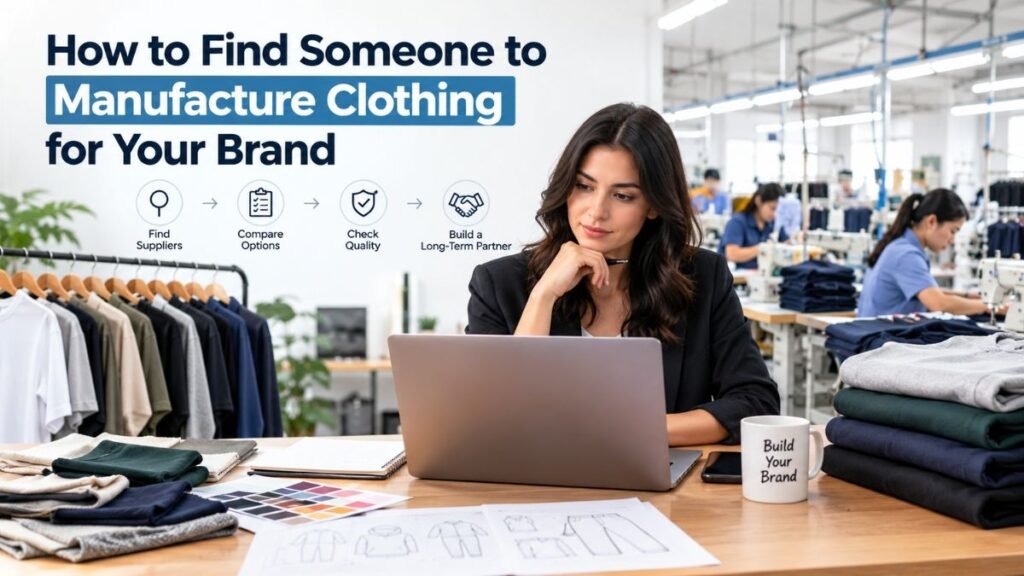
Finding the right clothing manufacturer is an important step in building a successful fashion brand. A reliable partner can help turn your designs into high-quality products. They can also support your growth as your business expands.
However, choosing a manufacturer takes careful research. You need to compare production costs, fabric quality, minimum order quantities, and manufacturing capabilities. You must also check communication, delivery times, and product samples before making a decision.
If you are starting a clothing line, the process may feel confusing. You might not know where to search or which questions to ask. Fortunately, several methods can help you find a suitable manufacturing partner.
This guide explains how to find someone to manufacture clothing for your brand. You will learn where to search, how to compare suppliers, and how to prepare for production. These steps can help you make informed decisions and avoid common manufacturing mistakes.
What Does a Clothing Manufacturer Do?
A clothing manufacturer produces garments based on your requirements. These requirements may include your designs, measurements, fabrics, colors, labels, and packaging.
Some manufacturers offer complete production services. They may help with fabric sourcing, pattern making, sampling, cutting, sewing, finishing, and packaging. Others focus on specific stages of garment production.
The services available depend on the factory and your agreement. Therefore, you should understand what each manufacturer offers before choosing one.
A clothing manufacturer can support many types of businesses. These include startups, established fashion labels, private-label brands, and online clothing stores.
For example, you may want to produce T-shirts, hoodies, activewear, uniforms, or denim products. Each category requires different equipment and production skills. Choosing a factory with relevant experience can improve product quality and consistency.
1. Define Your Clothing Brand Requirements
Before searching for a manufacturer, identify exactly what you want to produce. Clear requirements help you find factories that match your needs.
Start by defining your clothing category. Decide whether your brand will sell streetwear, sportswear, casual clothing, formalwear, or another product type.
Next, outline your product specifications. Include the fabric type, colors, sizes, fit, stitching, and finishing details. If you already have designs, prepare sketches or reference images.
You should also estimate your first production quantity. Some factories specialize in small orders, while others focus on large production runs.
Your budget matters, too. Calculate how much you can spend on sampling, materials, manufacturing, shipping, and packaging.
Prepare a basic manufacturing brief that includes:
- Clothing types and product designs
- Fabric preferences and material specifications
- Size range and color options
- Estimated order quantity
- Target production cost per garment
- Required delivery date
- Labeling and packaging requirements
This information gives potential manufacturers a clear understanding of your project. It also helps them provide more accurate quotations.
2. Decide Between Local and Overseas Clothing Manufacturers
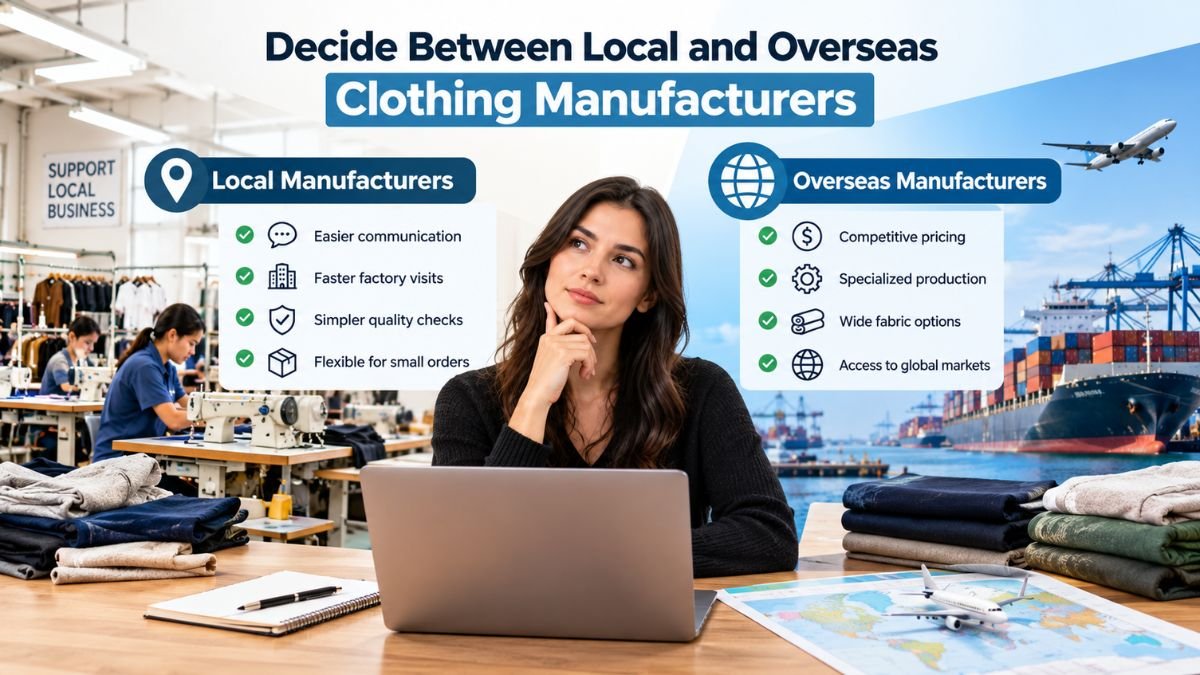
One of your first decisions is whether to work with a local or overseas manufacturer. Both options have advantages and limitations.
Local manufacturers may offer easier communication and faster factory visits. You may also find it simpler to inspect samples and discuss production changes. However, local production costs can be higher in some markets.
Overseas manufacturers may offer competitive pricing, specialized production facilities, or access to established textile supply chains. However, international orders can involve longer shipping times, import duties, and more complicated communication.
The best choice depends on your business model and product requirements.
Working With a Local Clothing Manufacturer
A local factory can be useful when you need close communication and greater oversight. You may be able to visit the production facility and review your garments in person.
This option can also help when you need smaller production runs or frequent design changes. However, you should still compare minimum order quantities and production costs.
Working With an Overseas Clothing Manufacturer
An overseas supplier may provide access to a wider range of fabrics, production techniques, and garment categories. Some factories specialize in specific products, such as knitwear, denim, sportswear, or workwear.
Before choosing an international supplier, verify its business details and production capabilities. Request physical samples and clarify shipping terms, payment conditions, and quality standards.
Do not select a factory based on price alone. A lower quotation may not include every production cost.
3. Search Online for Clothing Manufacturers
Online research is one of the easiest ways to find clothing manufacturers. Many factories have websites, business profiles, and product catalogs that describe their services.
Start by searching for manufacturers that specialize in your clothing category. Use specific phrases rather than broad searches.
For example, you can search for:
- Custom clothing manufacturers
- Private-label clothing manufacturers
- Small-batch garment manufacturers
- Streetwear manufacturers for startups
- T-shirt and hoodie manufacturers
- Activewear manufacturing companies
- Cut-and-sew clothing factories
Review each company’s website carefully. Look for product examples, manufacturing services, factory information, and contact details.
Pay attention to the types of garments shown in its portfolio. A factory that regularly produces your product category may understand its construction requirements better.
You can also use business directories and B2B marketplaces to discover potential suppliers. However, marketplace listings do not automatically prove that a company is trustworthy.
Contact several manufacturers and compare their responses. Ask for detailed quotations, sample policies, and production information.
4. Use B2B Marketplaces to Find Garment Manufacturers
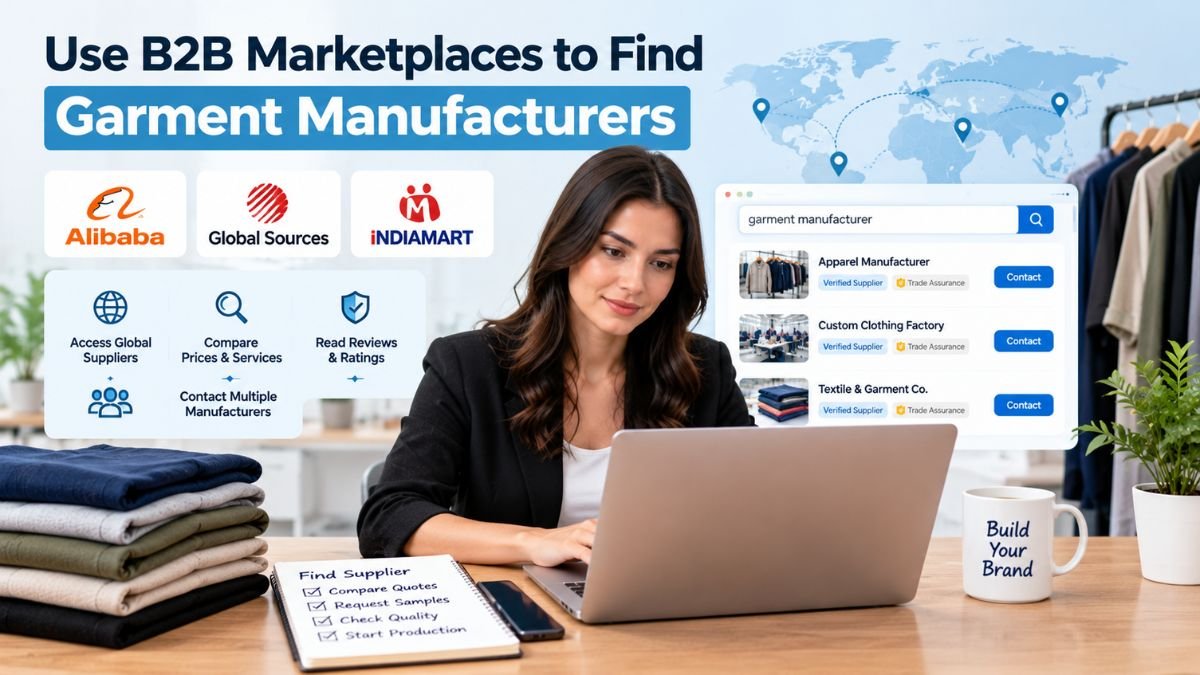
B2B marketplaces connect clothing brands with suppliers from different countries. They can help you compare production services and contact multiple manufacturers.
Some popular platforms include Alibaba, Global Sources, and IndiaMART. Their supplier coverage and verification services vary, so review each listing independently.
Search for manufacturers that match your product category and expected order quantity. Read company profiles, inspect product photographs, and review available business information.
Ask suppliers whether they own their production facilities or outsource manufacturing. This distinction matters because you need to understand who will actually produce your garments.
Before placing a large order, request samples and verify the supplier’s capabilities. Confirm the specifications, payment terms, delivery schedule, and quality requirements in writing.
Never assume that a supplier is reliable simply because it has a polished profile or many product listings. Independent verification remains essential.
5. Attend Clothing and Textile Trade Shows
Trade shows can help you meet manufacturers and textile suppliers directly. They also provide opportunities to inspect fabrics, discuss product ideas, and compare production services.
Look for events focused on apparel sourcing, garment manufacturing, textiles, or private-label production. Choose events that attract suppliers from your target clothing category.
Prepare questions before attending. Ask about minimum order quantities, sample development, production capacity, fabric sourcing, and quality control.
Bring product sketches or a manufacturing brief to explain your requirements. This makes conversations more productive.
After the event, contact promising suppliers and request detailed quotations. Keep notes about each factory so you can compare its services objectively.
Trade shows can be particularly useful when you want to build long-term supplier relationships. However, meeting a supplier in person does not replace proper verification and sample testing.
6. Evaluate Each Clothing Manufacturer Carefully
Once you have a shortlist, evaluate each manufacturer against your business needs. A suitable factory should offer the right combination of quality, pricing, communication, and production capacity.
Start by reviewing its experience. Ask which clothing categories it produces regularly and whether it has worked with brands similar to yours.
Next, examine its manufacturing capabilities. Check whether it can handle your fabrics, construction methods, finishing requirements, and order volume.
You should also evaluate communication. A professional supplier should answer questions clearly and explain its production process.
Consider these important factors:
- Experience with your product category
- Fabric and material sourcing options
- Minimum order quantity
- Sampling costs and turnaround time
- Production capacity and lead times
- Quality inspection procedures
- Payment terms and contract conditions
- References and verifiable business information
Do not rely on one factor alone. The cheapest manufacturer may not deliver the quality your brand needs.
Compare several suppliers using the same criteria. This helps you make a more balanced decision.
7. Understand Minimum Order Quantities
Minimum order quantity, or MOQ, is the smallest quantity a manufacturer agrees to produce for an order. It is one of the most important factors for new clothing brands.
Some factories accept small orders, while others require larger quantities. The MOQ may also differ by garment style, fabric, color, or size.
For example, a factory may accept a smaller order for a basic T-shirt than for a custom jacket. Specialized fabrics and custom dyeing can increase minimum requirements.
Ask whether the MOQ applies to the total order or each style and color. Also, confirm whether different sizes can be included in the same production run.
If you are starting with a limited budget, look for small-batch clothing manufacturers. You can also ask about stock fabrics, simpler designs, or reduced customization.
Small production runs may cost more per garment. However, they can help you test customer demand before investing in larger quantities.
Choose an order size that balances unit cost with financial risk.
8. Request Clothing Samples Before Bulk Production
Samples allow you to evaluate a manufacturer’s work before committing to a large order. They are essential for checking fit, construction, fabric quality, and overall appearance.
Provide detailed specifications when requesting a sample. Include measurements, fabric composition, colors, stitching details, trims, and branding requirements.
When the sample arrives, inspect it carefully. Compare the garment against your original design and technical specifications.
Check the following details:
- Fabric feel, weight, and appearance
- Stitching strength and seam consistency
- Measurements and garment fit
- Color accuracy and print quality
- Zippers, buttons, and other trims
- Labels, logos, and finishing
- Shrinkage or color changes after suitable washing tests
Try the garment on the intended fit model when appropriate. Check how it moves and feels during normal wear.
If changes are needed, provide clear feedback and request a revised sample. You may need several rounds before approving the final version.
Remember that a sample fee may be separate from the bulk production cost. Confirm these charges before starting development.
9. Compare Clothing Manufacturing Costs
Understanding manufacturing costs helps you protect your budget and set realistic product prices.
The cost per garment depends on several factors. These include fabric choice, design complexity, order quantity, labor, printing, embroidery, trims, and finishing.
Custom designs often require more development work than basic garments. Premium materials and specialized construction can also increase costs.
Ask each manufacturer for an itemized quotation. It should explain what the quoted price includes and which services cost extra.
Your total production budget may include:
- Pattern making and sample development
- Fabric and other raw materials
- Cutting, sewing, and assembly
- Printing, embroidery, and trims
- Labels and packaging
- Quality inspection
- Freight, insurance, and import charges where applicable
Compare quotations carefully. One supplier may include packaging and finishing, while another may charge for them separately.
Ask how pricing changes with different order quantities. Larger orders may reduce the unit cost, but they also require more upfront investment.
Choose a manufacturer that fits your budget without sacrificing essential quality standards.
10. Check Fabric Sourcing and Material Quality
Fabric quality directly affects how your clothing looks, feels, and performs. Therefore, you should understand how your manufacturer sources materials.
Ask whether the factory purchases fabric from established suppliers or sources it through your specifications. Confirm the available compositions, weights, colors, and finishes.
For example, cotton may suit everyday T-shirts, while polyester blends can work well for certain performance garments. Fleece fabrics are common for hoodies, and stretch knits may suit activewear.
The right material depends on your product design and intended use.
Request fabric swatches before approving the final garment. Check texture, thickness, stretch, opacity, and color.
For products that require specific performance, discuss relevant tests with the manufacturer. These may include shrinkage, colorfastness, seam strength, or durability testing.
If sustainability is important to your brand, ask for supporting documentation for environmental or material claims. Do not rely on unsupported marketing statements.
Clear fabric requirements can prevent costly problems during bulk production.
11. Confirm Branding, Labels, and Customization
Your clothing manufacturer should understand how you want your products presented. Branding details can make your garments more recognizable and consistent.
Depending on the factory, available services may include screen printing, embroidery, heat transfers, woven labels, neck labels, hangtags, and custom packaging.
Ask which options are available in-house and which require outside suppliers. Outsourced services may affect cost and delivery time.
Provide approved artwork files and clear placement instructions. Specify logo dimensions, colors, label materials, and packaging requirements.
Check branding details on your samples before approving production. Even a well-made garment can fail your expectations if the logo placement or label design is incorrect.
You should also confirm ownership of your designs and artwork. Use written agreements where appropriate to clarify confidentiality, intellectual property, and permitted use.
12. Communicate Clearly With Your Manufacturer
Good communication helps prevent misunderstandings during garment development and production.
Share your expectations before work begins. Explain the design, target quality, required quantity, delivery date, and budget.
Use a technical pack whenever possible. This document can include garment measurements, construction details, fabric specifications, color references, artwork, and labeling instructions.
Agree on how updates will be shared. You might use email, video calls, messaging, or a supplier’s production management system.
Ask for progress updates at important stages. These may include material sourcing, sample approval, cutting, sewing, finishing, and final inspection.
Keep important decisions in writing. Verbal discussions can lead to confusion when several product details are involved.
A reliable manufacturer should communicate delays and problems promptly. You should also respond to questions quickly to avoid unnecessary production delays.
13. Verify the Manufacturer’s Reliability
Before paying a deposit or placing a large order, verify the company as thoroughly as possible.
Request its registered business name, business address, contact details, and relevant company documents. Where possible, check these details against independent records.
Ask for references from previous clients, especially brands that produce similar garments. You can also request a video call or virtual factory tour.
If practical, arrange an in-person factory visit or use an independent inspection service. These steps can help you understand the facility and its actual capabilities.
Be cautious if a supplier refuses reasonable verification, pressures you to pay immediately, or provides inconsistent information.
Avoid sending large payments to unverified accounts. Confirm the payment recipient and agree on written terms before transferring money.
You should also discuss how defects, missed deadlines, and production disputes will be handled. Clear agreements help protect both parties.
14. Understand Production Timelines and Delivery
Production timelines affect your launch date, marketing plans, and inventory management. Therefore, confirm the expected schedule before placing your order.
Manufacturing lead times vary by product complexity, fabric availability, order size, and factory workload. Sampling and revisions can add extra time.
Ask for separate estimates for sample development, material sourcing, bulk production, finishing, and shipping.
Confirm when the production clock starts. Some manufacturers begin only after sample approval, deposit payment, or material confirmation.
Discuss how delays will be communicated and managed. If your brand has a fixed launch date, allow extra time for unexpected issues.
For international orders, account for freight, customs clearance, and potential import delays. Ask whether the quotation covers shipping or only factory production.
A realistic schedule is more useful than an overly optimistic promise. Build your launch plan around confirmed milestones and reasonable contingency time.
15. Start With a Small Production Order
When possible, begin with a manageable order before committing to large-scale production. This gives you an opportunity to evaluate the manufacturer’s consistency.
A successful sample does not always guarantee that every bulk garment will match it. Production conditions, materials, and workmanship can vary.
A smaller initial order can help you assess sizing consistency, stitching, finishing, packaging, and delivery performance.
Inspect the finished garments against your approved sample and specifications. Record any defects and discuss corrective actions with the factory.
If the order meets your standards, you can consider increasing quantities for future production runs.
However, a small order may not be available from every factory. Confirm its minimum requirements before making your decision.
The goal is to reduce risk while building a reliable manufacturing relationship.
16. Avoid Common Clothing Manufacturing Mistakes
New clothing brands can lose time and money by rushing the supplier selection process. Careful planning can help you avoid many common problems.
One frequent mistake is choosing a factory based only on price. Low production costs are useful, but poor quality can lead to returns, complaints, and wasted inventory.
Another mistake is skipping samples. Always evaluate the product before approving bulk production whenever the manufacturing arrangement allows it.
Avoid vague product specifications. Without clear measurements and material details, the factory may interpret your requirements differently.
You should also avoid placing orders without written agreements. Confirm pricing, quantities, deadlines, payment terms, and quality expectations.
Other mistakes include:
- Ordering more inventory than your budget can support
- Ignoring shipping and import costs
- Failing to verify supplier information
- Changing designs after production begins
- Overlooking fabric testing and quality checks
- Accepting unclear payment or refund conditions
- Leaving too little time for sample revisions
A structured process helps you make better decisions. It also creates clearer expectations for both your brand and your manufacturing partner.
17. Build a Long-Term Relationship With Your Manufacturer
Finding a clothing manufacturer is not only about completing one order. A dependable supplier can become an important partner as your brand grows.
Treat the relationship professionally. Provide accurate specifications, approve samples on time, and pay according to agreed terms.
Share constructive feedback when problems arise. Explain what needs improvement and agree on practical solutions.
Track product quality, delivery performance, communication, and order accuracy. These records can help you decide whether to continue working with the supplier.
As demand increases, discuss capacity, pricing, material availability, and future production plans.
A long-term relationship may lead to smoother communication and better production planning. However, continue monitoring quality rather than assuming every future order will be perfect.
You should also maintain alternative supplier options when practical. Having a backup can help reduce disruption if your main manufacturer becomes unavailable.
Conclusion
Learning how to find someone to manufacture clothing for your brand requires research, planning, and careful evaluation. The right manufacturer should understand your products, meet your quality standards, and support your production goals.
Start by defining your clothing requirements and searching through relevant directories, marketplaces, and trade shows. Compare local and overseas options based on your needs.
Next, review supplier experience, minimum order quantities, costs, and production capabilities. Request samples, verify business information, and confirm every important detail in writing.
Begin with a manageable order when possible. Inspect the finished garments and evaluate the supplier’s performance before increasing production.
With a clear process and reliable communication, you can find a manufacturing partner that supports your brand’s development and long-term growth.
Frequently Asked Questions
How do I find a clothing manufacturer for my brand?
Start by defining your product requirements and budget. Search online directories, B2B marketplaces, trade shows, and industry networks. Compare manufacturers based on experience, MOQ, quality, pricing, and communication. Request samples and verify the supplier before placing a bulk order.
How much does it cost to manufacture clothing?
Clothing manufacturing costs vary by garment type, fabric, design complexity, order quantity, and production location. Sampling, labels, packaging, shipping, and duties can add to the total. Request itemized quotations from several manufacturers to compare the full cost.
Can I find a clothing manufacturer with a low minimum order quantity?
Yes. Some manufacturers specialize in small-batch production for startups and independent brands. However, minimum quantities depend on the garment, fabric, customization, and factory. Ask about smaller runs and stock materials before committing to an order.
Should I choose a local or overseas clothing manufacturer?
Choose based on your budget, product requirements, communication needs, and delivery schedule. Local production may make visits and coordination easier. Overseas production may offer different pricing or specialized capabilities, but shipping and import costs require careful planning.
What should I send a clothing manufacturer?
Send a clear manufacturing brief with designs, measurements, fabric requirements, colors, sizes, order quantities, and branding details. A technical pack is especially useful for custom garments. Include your target cost and delivery requirements when requesting a quotation.
How can I check if a clothing manufacturer is reliable?
Review its business information, experience, references, and manufacturing capabilities. Request samples and inspect them against your specifications. Arrange a factory visit or independent inspection when practical. Confirm payment terms, quality standards, and delivery commitments in writing.
Do clothing manufacturers help with fabric sourcing?
Many manufacturers offer fabric sourcing as part of their services. Others require brands to supply materials themselves. Ask about fabric options, supplier documentation, minimum purchasing quantities, and material testing before selecting a production partner.
How long does clothing manufacturing take?
The timeline depends on sample development, material availability, order size, garment complexity, and factory capacity. Shipping adds more time for international orders. Ask for a schedule covering sampling, production, finishing, inspection, and delivery.
What is the difference between a clothing manufacturer and a clothing supplier?
A clothing manufacturer produces garments or manages their production. A clothing supplier may sell finished garments, distribute products, or connect buyers with factories. Some businesses perform both roles, so clarify who will manufacture your order.
Can a beginner start a clothing brand with a manufacturer?
Yes. Beginners can work with manufacturers that support small orders and product development. Start with a clear design, realistic budget, and manageable quantity. Approve samples, verify the supplier, and test customer demand before scaling production.